
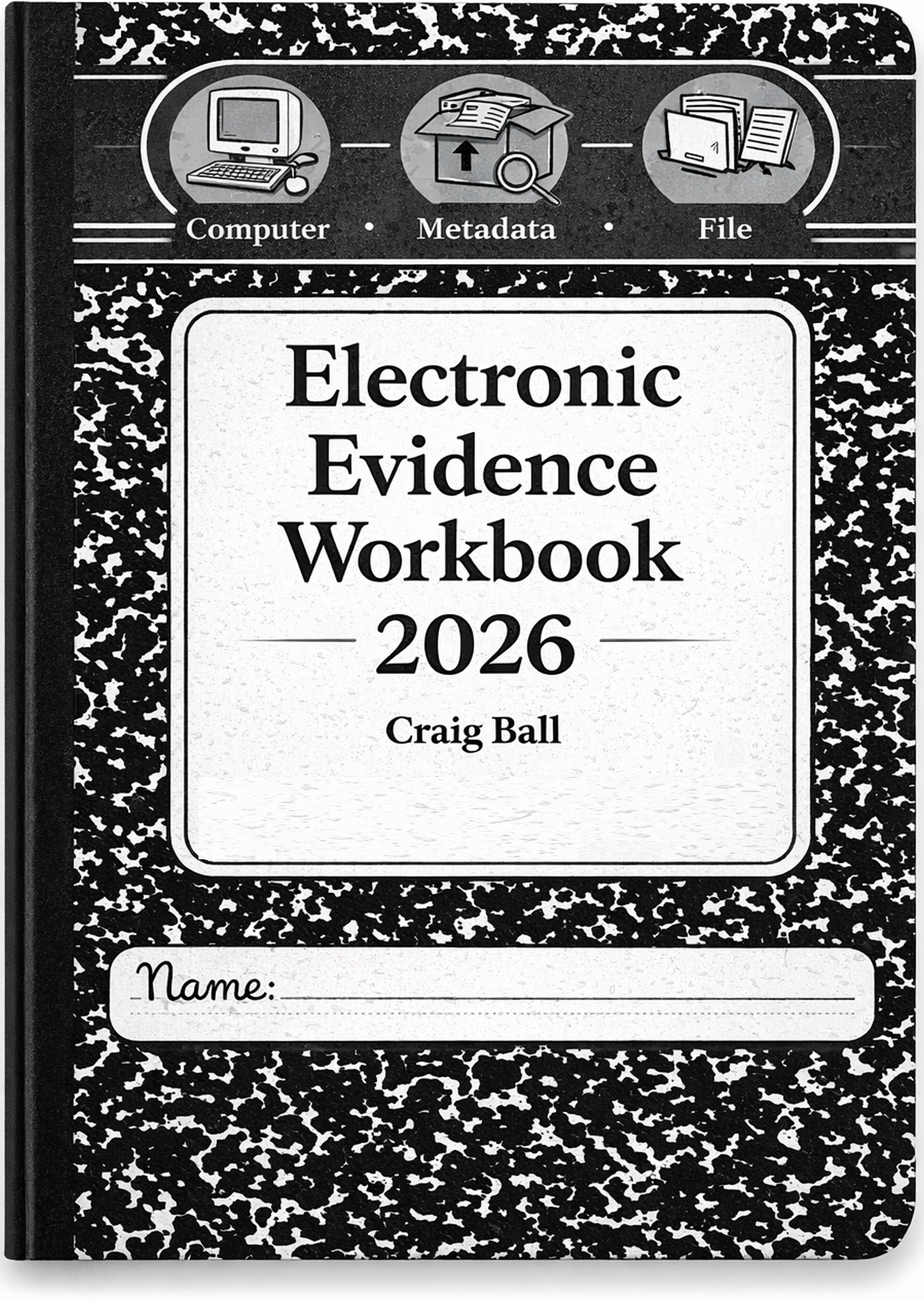
Today marks the end of Carnival season in New Orleans. The tourists depart, the city exhales, and we pack away costumes and beads. My own sigh of relief has less to do with the end of revelry than with finishing the 2026 edition of my Electronic Evidence Workbook—a thoroughly revised 638 pages. This edition leans into LLMs, reflecting the growing imperative that law schools graduate students who can use AI competently, ethically, and strategically.
For the first time, I put myself in the hands of AI editors—two of them—to help proof, tighten, and update entire chapters. I’m especially pleased to include a full-fledged forensic imaging exercise for the many Mac users in my classes who’ve long struggled to find free imaging tools that run on macOS. The workflow relies on Terminal and the command line, giving students a taste of what computing felt like through much of my early career.
While I retained material on topics like tape backup and on-prem email, the revision acknowledges the ascendancy of the cloud and post-pandemic changes in the workplace. Students are thrown into the deep end by Exercise 3, working in a commercial e-discovery platform even as they take their first steps eastward along the EDRM. My approach remains deliberately heavy on systems and forensics. Law schools do a fine job teaching students to find the law and interpret decisions, but they too rarely show how technology actually works in the messy trenches of modern digital life.
Working with an LLM to revise the Workbook proved as educational for me as for my students. Preserving my voice and experience on every page required vigilance, but collaborating with such a careful and capable editor was a genuine pleasure.
So it’s finally out there—much the same workbook, yet changed by AI like its author.
 Ball in your Court