• Home
  • About
  • CRAIGBALL.COM
  • Disclaimer
  • Log In

Ball in your Court

~ Musings on e-discovery & forensics.

Ball in your Court

Monthly Archives: October 2014

Rule 34: Grewal Ventures an Opinion

21 Tuesday Oct 2014

Posted by craigball in E-Discovery

≈ 1 Comment

Judge-GrewalU.S. Magistrate Judge Paul S. Grewal (pronounced “grey-wahl”) cuts an impressive figure in the e-discovery community.  In less than four years on the bench, Judge Grewal has written several opinions addressing instances of discovery incompetence and misconduct in epic battles between the tech titans tramping through his court in San Jose, California.  His latest is an order on a Motion to Compel and for Sanctions in a patent dispute, Venture Corp., LTD v. James P. Barrett.  It’s a fight between a multi-billion dollar Singapore tech concern and an inventor.  In praising Judge Grewal, I feel obliged to point out that he enjoyed an unfair advantage over the litigants in that His Honor read the Federal Rules of Civil Procedure, particularly Rule 34, which Judge Grewal termed “about as basic to any civil case as it gets.”  No fair reading the rules, Judge! Continue reading →

Share this:

  • Email a link to a friend (Opens in new window) Email
  • Print (Opens in new window) Print
  • Share on X (Opens in new window) X
  • Share on Facebook (Opens in new window) Facebook
  • Share on LinkedIn (Opens in new window) LinkedIn
Like Loading...

Does Evidence Derive from Discovery?

16 Thursday Oct 2014

Posted by craigball in E-Discovery, Uncategorized

≈ 14 Comments

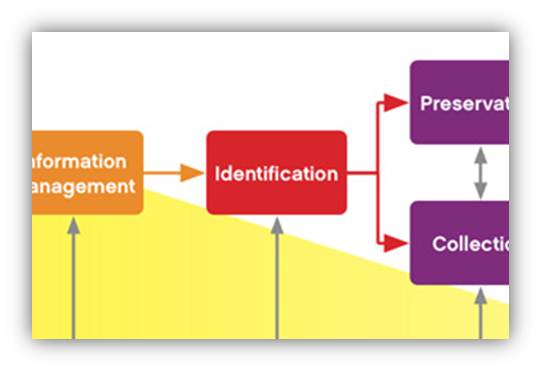
edrm-IDIs anyone else troubled that the most oft-cited research into e-discovery–the Blair & Marron study of keyword search–dates from 1985? Recent “studies” are often seat-of-the-pants opinion polls of the sort that ask in house counsel to guess how well prepared their companies are to deal with e-discovery or what they think discovery costs. These are interesting; but, they’re no more reliable than polls asking people to rate themselves as “fair minded” or “intelligent.” Polls measure people’s expectations about what facts might be, not facts. The long-held consensus that the sun circled a flat Earth didn’t make it so.

We need objective metrics in e-discovery, and one thing I’d like to see measured is the origin of the information obtained in discovery that’s actually used to prosecute or defend cases. My experience is that cases are won or lost using a handful of items versus the number exchanged in discovery. Do the exhibits used in motions, depositions and trials derive from e-discovery or do they emerge by other means? Continue reading →

Share this:

  • Email a link to a friend (Opens in new window) Email
  • Print (Opens in new window) Print
  • Share on X (Opens in new window) X
  • Share on Facebook (Opens in new window) Facebook
  • Share on LinkedIn (Opens in new window) LinkedIn
Like Loading...

Preserving Gmail for Dummies

15 Wednesday Oct 2014

Posted by craigball in Computer Forensics, E-Discovery

≈ 12 Comments

gmail_GoogleI posted here a year ago laying out a detailed methodology for collection and preservation of the contents of a Gmail account in the static form of a standard Outlook PST.  Try as I might to make it foolproof, downloading Gmail using IMAP and Outlook is tricky.  Happily since my post, the geniuses at Google introduced a truly simple, no-cost way to collect Gmail and other Google content for preservation and portability.  It sets a top flight example for online service providers, and presages how we may use the speed, power and flexibility of Google search as a culling mechanism before exporting for e-discovery. Continue reading →

Share this:

  • Email a link to a friend (Opens in new window) Email
  • Print (Opens in new window) Print
  • Share on X (Opens in new window) X
  • Share on Facebook (Opens in new window) Facebook
  • Share on LinkedIn (Opens in new window) LinkedIn
Like Loading...

Sedona Principle Six: Overdue for an Overhaul

10 Friday Oct 2014

Posted by craigball in E-Discovery

≈ 9 Comments

moleThe Sedona Conference “Best Practices Recommendations & Principles for Addressing Electronic Document Production (2d Edition 2007)” still impresses me as a thoughtful and balanced articulation of how electronic discovery should proceed.  Yet, each time I read them, Principle Six stands out like a witch’s hairy mole on a pretty face.

Sedona Principle 6 is overdue for an overhaul:  It’s out of synch with reality, and always has been.

The current Principle Six states, “Responding parties are best situated to evaluate the procedures, methodologies, and technologies appropriate for preserving and producing their own electronically stored information.”

Sometimes responding parties are best situated.  But, sometimes they are foxes guarding henhouses, and sometimes possess so little competence that their folly serves as fodder for sanctions.

The presumption of superior competence is belied by the reality of widespread confusion and incompetence.  Yes, an organization may better know its own data for it’s in a superior position to know; but, it’s foolish to assume they possess a superior ken of their data with respect to its identification, preservation and transit into and through e-discovery.  That’s a specialty. Continue reading →

Share this:

  • Email a link to a friend (Opens in new window) Email
  • Print (Opens in new window) Print
  • Share on X (Opens in new window) X
  • Share on Facebook (Opens in new window) Facebook
  • Share on LinkedIn (Opens in new window) LinkedIn
Like Loading...

Encoding in E-Discovery: Reductio ad Absurdum

01 Wednesday Oct 2014

Posted by craigball in Computer Forensics, E-Discovery

≈ 3 Comments

ovationIn his keynote speech at the Zapproved Preservation Excellence Conference in Portland, Dr. Tony Salvador of Intel compared the “encores” of performers today to those of performers a century ago. “Encore,” Salvador noted, is French for “again;” yet, we use it to mean “more.”  Today, performers brought back by applause don’t repeat their performance; they play a different song.

But for hundreds of years, the encore was an unpredictable, spontaneous eruption.  Stirred by a brilliant aria in the midst of a performance, members of the audience would leap to their feet in applause, shouting, “ENCORE! ENCORE!” The singer and musicians were compelled to stop and perform the same song AGAIN.  This might happen over and over, until the rapture was so fixed in the listeners’ minds they’d relent and let the performance continue.

The audiences of the 18th and 19th centuries demanded repetition of what they heard because there was no technology to reproduce it.  Once Edison made sound stick to a cylinder, the mid-show encore disappeared, and the race to record everything began.

The natural world is an analog world.  The signals to our senses vary continuously over time, experienced as waves of light, vibration or other stimuli.  Much of the last century was devoted to recording analogs of these analogs; that is, preserving the waves of the natural world as waves that could be impressed upon tinfoil, wax and vinyl, as areas of transparency and opacity on photographic film or as regions of varying magnetic intensity on tape.

Then, late in the 20th century, we learned to mimic analog information using the rapid “on” and “off” of digital data, and devoted the last quarter of the century to converting our vast collection of analog recordings to digital forms.  ENCORE! ENCORE! (But this time, do it in ones and zeroes, okay?). It was my generation’s take on converting manuscripts to movable type in the middle ages. Continue reading →


Share this:

  • Email a link to a friend (Opens in new window) Email
  • Print (Opens in new window) Print
  • Share on X (Opens in new window) X
  • Share on Facebook (Opens in new window) Facebook
  • Share on LinkedIn (Opens in new window) LinkedIn
Like Loading...
Follow Ball in your Court on WordPress.com

Enter your email address to subscribe to this blog and receive notifications of new posts by email.

Join 2,233 other subscribers

Recent Posts

  • A Dog and Its Tail: Don’t Let Version Uncertainty Cloud Linked Attachment Production April 2, 2026
  • The EDRM Isn’t Broken; It’s Misunderstood. March 18, 2026
  • Detecting Deep Fakes February 24, 2026
  • A Fun Way to Build AI Fluency February 21, 2026
  • Electronic Evidence Workbook 2026 February 18, 2026

Archives

RSS Feed RSS - Posts

CRAIGBALL.COM

Helping lawyers master technology

Categories

EDD Blogroll

  • E-D Team (Ralph Losey)
  • The Relativity Blog
  • GLTC (Tom O'Connor)
  • Illuminating eDiscovery (Lighthouse)
  • Complex Discovery (Rob Robinson)
  • Basics of E-Discovery (Exterro)
  • eDiscovery Today (Doug Austin)
  • E-Discovery Law Alert (Gibbons)
  • CS DISCO Blog
  • Minerva 26 (Kelly Twigger)
  • Sedona Conference
  • Corporate E-Discovery Blog (Zapproved )
  • eDiscovery Journal (Greg Buckles)

Admin

  • Create account
  • Log in
  • Entries feed
  • Comments feed
  • WordPress.com

Enter your email address to follow Ball in Your Court and receive notifications of new posts by email.

Website Powered by WordPress.com.

  • Subscribe Subscribed
    • Ball in your Court
    • Join 2,085 other subscribers
    • Already have a WordPress.com account? Log in now.
    • Ball in your Court
    • Subscribe Subscribed
    • Sign up
    • Log in
    • Report this content
    • View site in Reader
    • Manage subscriptions
    • Collapse this bar
 

Loading Comments...
 

    %d