
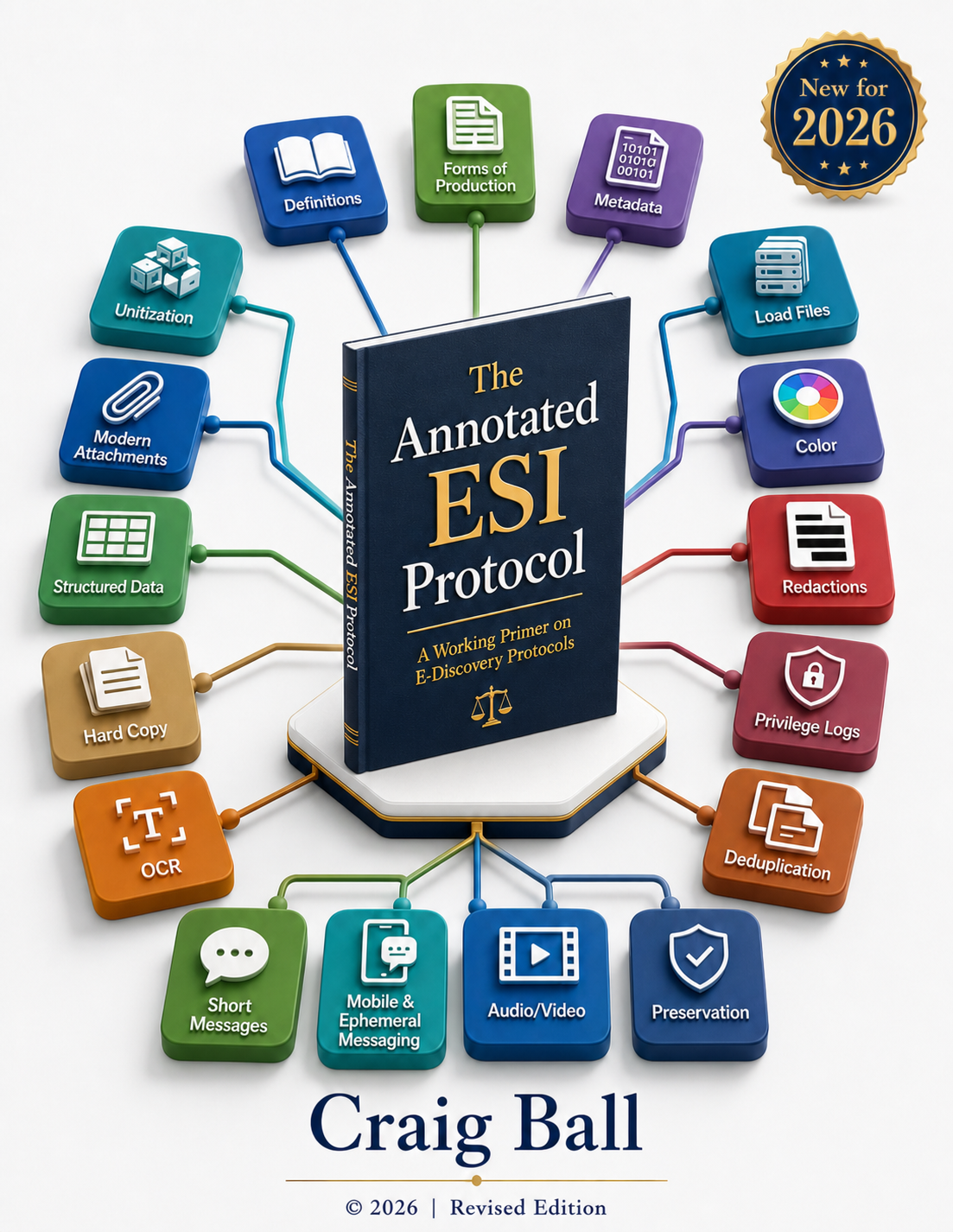
When I first published The Annotated ESI Protocol in January 2023, I hoped it would age the way most legal writing ages: slowly, with a few footnotes for the curious. Three years on, I’m releasing a substantially revised edition because the evidence has changed, and the protocols we negotiate need to change with it. The tools custodians use to communicate and collaborate in 2026 look materially different from just a few years ago, and the revised Annotated ESI Protocol seeks to address what we must accomplish today.
Download it here: http://www.craigball.com/Annotated_ESI_Protocol_2026_Final.pdf
The biggest changes are additions. Modern attachments—the cloud-hosted documents people send by pointers instead of as embedded files—now have their own section, with an exemplar provision distinguishing genuine substitute-attachments from documents merely referenced, a point-in-time-version obligation calibrated to what current collection tools can deliver, and a meet-and-confer trigger for cases where historical-version recovery genuinely matters. Short-message and collaboration-platform data—Slack, Teams, Google Chat—have a section requiring native export, a human-readable rendered transcript plus separately-produced attachments, with proportionality qualifiers acknowledging that not every producing party’s tooling produces all three out of the box. Mobile and ephemeral messaging get a tiered approach: consumer-grade backup-extraction utilities like iMazing are often acceptable for the run-of-the-mill civil cases, with forensic-grade collection (Cellebrite, AXIOM, and the rest) reserved for matters where alleged spoliation, deleted-content recovery, or device-integrity disputes warrant the greater rigor and cost. Audio, video, and voicemail get explicit native-production language. Search methodology, technology-assisted review, and generative AI in review each have their own short sections governing disclosure and validation. Foreign-language materials, which I had flagged in 2023 without addressing, now have an exemplar provision. In the years since I penned the original, we’ve benefited from insight on these topics gleaned from published case authority and thoughtful scholarship. The times are still a-changing and I’m reluctant to wade into contentious and unsettled topics; but at the same time, practitioners need guidance to move forward. Embrace what serves you and leave the rest.
A hybridized TIFF+ exemplar remains the primary form of production, because that’s what most institutional litigation still demands and a protocol that pretends otherwise won’t get traction, no matter the retrograde inefficiency of converting robust native formats to static images. But, the carve-outs for native production have grown to cover spreadsheets, presentations, databases, photographs, audio, video, short messages, mobile messages, structured-data exports, CAD, and anything else that doesn’t reduce sensibly to a static page image. If you can hold the line for native (instead of holding your nose for TIFFs), native is still better; the alternative language to get it is in there.
Addendum A addressing load file metadata production has expanded from twenty-seven fields to roughly sixty, organized into eleven labeled subsections covering the new evidence types, with explicit fields for collection-tool disclosure, modern-attachment metadata, conversation identifiers, edit and deletion flags, and platform tier. Thanks to the vigilance of my crack AI editor, a handful of drafting glitches in the 2023 edition are fixed.
The 2026 edition also acknowledges more directly than its predecessor that what counsel can demand and what a producing party’s platform and subscription tier can deliver are sometimes different things. The revised protocol asks more of producing parties—inevitably, considering all the new forms of ESI extant—but the new sections build in proportionality qualifiers, disclosure obligations and meet-and-confer triggers calibrated to what the leading platforms actually support in 2026. ESI protocols are still worth fighting for, and the better both sides understand their application and purpose, the less there is to bicker about.
If you’re interested in ESI Protocols and want to contribute your experience to an EDRM effort to frame a path to consensus protocols, please share your interest at https://edrm.net/edrm-projects/esi-protocol/
 Ball in your Court
Pingback: Week 18 – 2026 – This Week In 4n6
Pingback: A Refresh of the Annotated ESI Protocol