
 Lawyers spend a ton of time thinking about intent. Intent is what separates murder from negligent homicide. It’s key to deciding whether minds have met to form a binding contract. Intentional torts are punished. Notions of intent pervade the law: testamentary intent, transferred intent, malice, bad faith, mens rea, scienter and premeditation. The intent of the framers of the U.S. Constitution was the linchpin of the late Justice Antonin Scalia’s interpretation of that great document.
Intent is the attitude with which one acts. It can be general intent in the sense of acting in the way you meant to act, or it can be specific intent in anticipating and seeking a specific outcome. Intent is all in the mind.
Proving intent is one of the harder things trial lawyers do. Short of the rare Perry Mason moment when a party confesses intent ( i.e., “You’re damn right I killed him, and I’d do it again. The bastard NEEDED killing!!”), lawyers must resort to evidence that illuminates the intent of a specific person or corporation or that of a reasonable person or corporation similarly situated in terms of what he, she or it would have thought, anticipated or known.
When lawmakers demand proof of intent, they necessarily contemplate that evidence of intent be brought forward. Lawyers must be able to delve into intent and discover direct and circumstantial evidence of intent. We must be permitted to probe the knowledge, experience, attitudes, motives, expectations and prejudices of the person or entity whose intent is at issue.
Because intent is elemental but difficult to prove directly, the law gives leeway to the discovery process. For example, Courts generally prohibit evidence of other wrong acts or bad character to prove a specific act in accordance with character or traits but make an exception and permit the evidence to come in when prior bad acts show intent. Federal Rules of Evidence Rule 404(b)(2).
All of this is prelude to discussing the broader impact of amended Rule 37(e) of the Federal Rules of Civil Procedure, now requiring a finding of an “intent to deprive” as predicate for sanctioning evidence destruction and discovery obstruction. Continue reading
 Can anyone doubt the changes wrought by the modern “smart” cellphone? My new home sits at the corner of one-way streets in New Orleans, my porch a few feet from motorists. At my former NOLA home, my porch faced cars stopped for a street light. From my vantage points, I saw drivers looking at their phones, some so engrossed they failed to move when they could. Phones impact how traffic progresses through controlled intersections in every community. We are slow-moving zombies in cars.
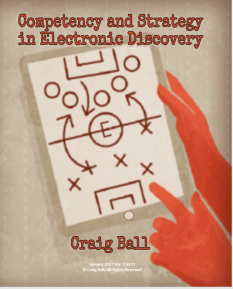 Two characteristics that distinguish successful trial lawyers are preparation and strategy.
 If you are in New York on Monday evening, please come hear me interview Nina Totenberg, NPR’s legendary legal affairs correspondent, and honor your peers in the corporate and government e-discovery world who are being recognized for excellence in e-discovery strategy, process and success. We will also honor noted author Michael Arkfeld for his contributions.
 Bill Butterfield died on Tuesday, December 13 after a brief, silent battle with cancer. He was a good man and an exemplary attorney. Knowing that I will never meet him again, I mourn that I cannot know him better. I know well Bill’s tireless efforts to protect every litigant’s right to obtain full and fair discovery. His was a revered and respected voice at The Sedona Conference, where he stood against multitudes who would cripple our right to seek the truth that lives in electronically-stored information. Bill employed canny strategies that the naysayers couldn’t match: He was sensible, practical, courteous and kind. Bill listened. He considered, and he contributed. Bill was a worthy opponent to many, an enemy to none.
 “Will the person who left their cell phone at the security checkpoint please retrieve it?” People constantly leave their phones behind at security checkpoints, washrooms, checkout counters and charge stations. Too, the little buggers slip out of pockets and purses. More than three million phones are lost in the U.S. every year, and less than one-in-ten lost phones finds its way home. Saturday night, I found an iPhone on the floor at a big party in the Faubourg Marigny in New Orleans. I located the owner by asking everyone in sight if they’d lost a phone, and when I found her, the owner didn’t know she’d dropped it.


 As I stow the turkey platter and box up the pilgrim décor, I’m reminded that it’s time once more to celebrate E-Discovery Day, TODAY, Thursday, December 1. No doubt, you’re saying, “So SOON?!?! I still haven’t retrieved those E-Discovery Day 2015 balloons that got loose in the atrium, and who’s going to eat all that E-Discovery Day Kringle taking up space in the office freezer?” (Special-ordered from Racine in the traditional e-discovery flavor, Cinnamon, TIFF and Tears™).
 In the wee hours last evening, I received a question posed by Angela Bunting with Nuix down in Sydney, Australia. Angela has such deep knowledge of e-discovery above and below the Equator that I was flattered to be queried by someone I’d go to for guidance. It was a magnificent hypothetical question.