• Home
  • About
  • CRAIGBALL.COM
  • Disclaimer
  • Log In

Ball in your Court

~ Musings on e-discovery & forensics.

Ball in your Court

Tag Archives: LLM

Chambers Guidance: Using AI Large Language Models (LLMs) Wisely and Ethically

19 Thursday Jun 2025

Posted by craigball in ai, General Technology Posts, Law Practice & Procedure

≈ 3 Comments

Tags

ai, artificial-intelligence, chatgpt, generative-ai, law, LLM, technology

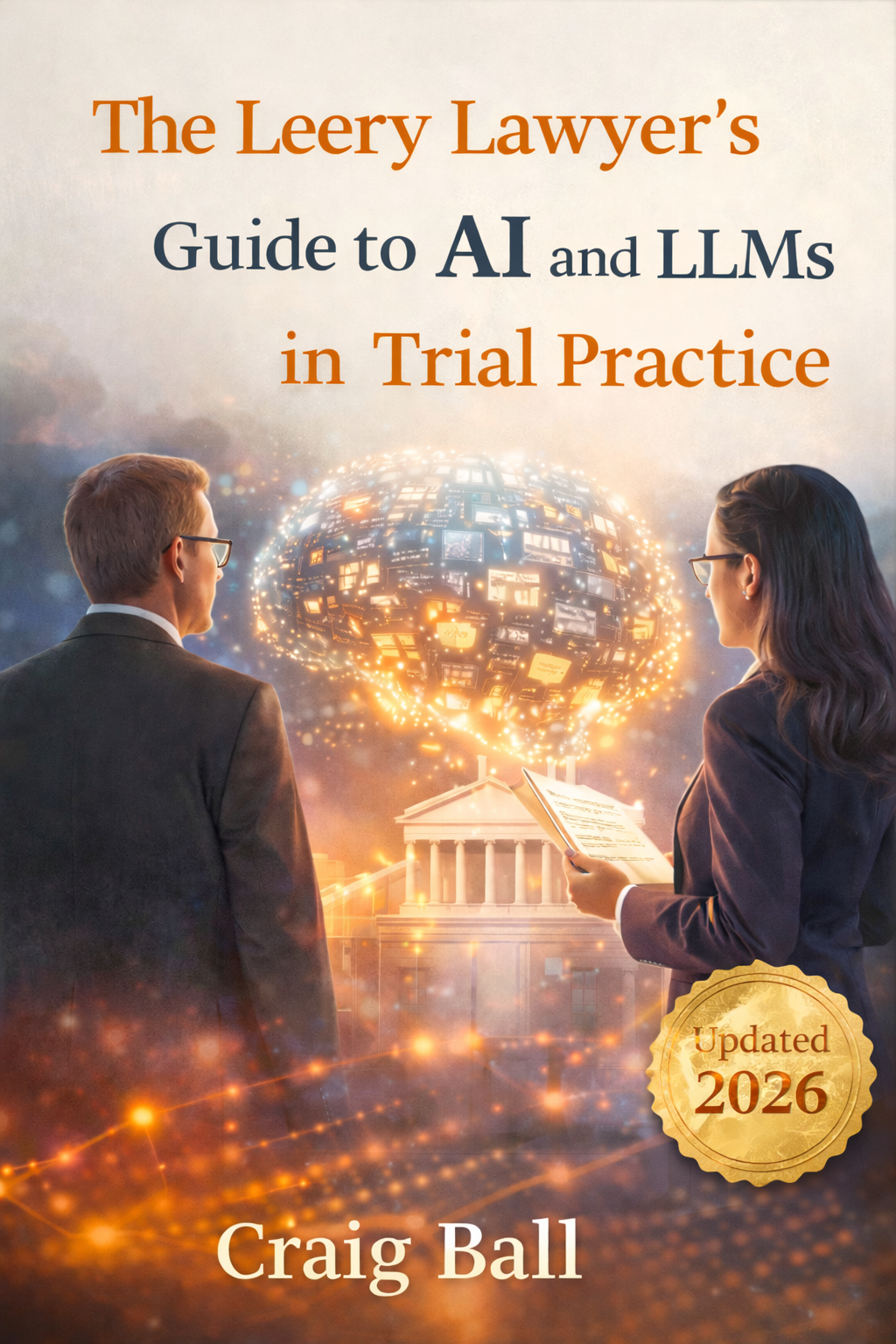
Tomorrow, I’m delivering a talk to the Texas Second Court of Appeals (Fort Worth), joined by my friend, Lynne Liberato of Houston. We will address LLM use in chambers and in support of appellate practice, where Lynne is a noted authority. I’ll distribute my 2025 primer on Practical Uses for AI and LLMs in Trial Practice, but will also offer something bespoke to the needs of appellate judges and their legal staff–something to-the-point but with cautions crafted to avoid the high profile pitfalls of lawyers who trust but don’t verify.

Courts must develop practical internal standards for the use of LLMs in chambers. These AI applications are too powerful to ignore and too powerful to use without attention given to safe use.

Chambers Guidance: Using AI Large Language Models (LLMs) Wisely and Ethically

Prepared for Second District Court of Appeals (Fort Worth)


Purpose
This document outlines recommended practices for the safe, productive, and ethical use of large language models (LLMs) like ChatGPT-4o in chambers by justices and their legal staff.


I. Core Principles

  1. Human Oversight is Essential
    LLMs may assist with writing, summarization, and idea generation, but should never replace legal reasoning, human editing, or authoritative research.
  2. Confidentiality Must Be Preserved
    Use only secure platforms. Turn off model training/sharing features (“model improvement”) in public platforms or use private/local deployments.
  3. Verification is Non-Negotiable
    Never rely on an LLM for case citations, procedural rules, or holdings without confirming them via Westlaw, Lexis, or court databases.  Every citation is suspect until verified.
  4. Transparency Within Chambers
    Staff should disclose when LLMs were used in a draft or summary, especially if content was heavily generated.  Prompt/output history should be preserved in chambers files.
  5. Judicial Independence and Public Trust
    While internal LLM use may be efficient, it must never undermine public confidence in the independence or impartiality of judicial decision-making. The use of LLMs must not give rise to a perception that core judicial functions have been outsourced to AI.

II. Suitable Uses of LLMs in Chambers

  • Drafting initial outlines of bench memos or summaries of briefs
  • Rewriting judicial prose for clarity, tone, or readability
  • Summarizing long records or extracting procedural chronologies
  • Brainstorming counterarguments or exploring alternative framings
  • Comparing argumentative strength and inconsistencies of and between parties’ briefs

Note: Use of AI output that may materially influence a decision must be identified and reviewed by the judge or supervising attorney.


III. Prohibited or Cautioned Uses

  • Do not insert any LLM-generated citation into a judicial order, opinion, or memo without independent confirmation
  • Do not input sealed or sensitive documents into unsecured platforms
  • Do not use LLMs to weigh legal precedent, assess credibility, or determine binding authority
  • Do not delegate critical judgment or reasoning tasks to the model (e.g., weighing precedent or evaluating credibility)
  • Do not rely on LLMs to generate summaries of legal holdings without human review of the supporting authority

IV. Suggested Prompts for Effective Use

These prompts may be useful when paired with careful human oversight and verification

  • “Summarize this 40-page brief into 5 bullet points, focusing on procedural history.”
  • “Summarize the uploaded transcript respecting the following points….”
  • “Summarize the key holdings and the law in this area”
  • “Rewrite this paragraph for clarity, suitable for a published opinion.”
  • “List potential counterarguments to this position in a Texas appellate context.”
  • “Explain this concept as if to a first-year law student.”

Caution: Prompts seeking legal summaries (e.g., “What is the holding of X?” or “Summarize the law on Y”) are particularly prone to error and must be treated with suspicion. Always verify output against primary legal sources.


V. Public Disclosure and Transparency

Although internal use of LLMs may not require disclosure to parties, courts must be sensitive to the risk that judicial reliance on AI—even as a drafting aid—may be scrutinized. Consider whether and what disclosure may be warranted in rare cases when LLM-generated language substantively shapes a judicial decision.

VI. Final Note

Used wisely, LLMs can save time, increase clarity, and prompt critical thought. Used blindly, they risk error, overreliance, or breach of confidentiality. The justice system demands precision; LLMs can support it—but only under a lawyer’s and judge’s careful eye and hand.


Prepared by Craig Ball and Lynne Liberato, advocating thoughtful AI use in appellate practice.

Of course, the proper arbiters of standards and practices in chambers are the justices themselves; I don’t presume to know better, save to say that any approach that bans LLMs or presupposes AI won’t be used is naive. I hope the modest suggestions above help courts develop sound practical guidance for use of LLMs by judges and staff in ways that promote justice, efficiency and public confidence.

Share this:

  • Click to email a link to a friend (Opens in new window) Email
  • Click to print (Opens in new window) Print
  • Click to share on X (Opens in new window) X
  • Click to share on Facebook (Opens in new window) Facebook
  • Click to share on LinkedIn (Opens in new window) LinkedIn
Like Loading...

Will AI Summarization Disrupt Discovery?

26 Friday Jan 2024

Posted by craigball in Uncategorized

≈ 6 Comments

Tags

AI artifiicla intelligence eDiscovery, generative-ai, LLM

Reader’s Digest, the century-old magazine with the highest paid circulation, has long published “condensed” books; anthologies of four-to-five popular novels abridged to fit in a single volume.  Condensed Books were once enormously popular, with tens of millions of copies in circulation.  They were also an abomination to serious readers, a literary Tang for those who preferred fresh-squeezed OJ. I’ve never read a condensed book, so I’m in no position to judge their merit save to say that I believe reading anything is a good thing.  I imagine the condensed versions conveyed the guts of the story well enough to sound like you’d read it over drinks with the neighbors before the Ed Sullivan show.

But I am enough of a purist (okay, “snob”) to worry about the impact of summarization.  As an undergraduate English major, I had to wade through some challenging tomes.  I have no empirical evidence for it, but I’m certain those books are a part of me in ways they never would have been had I sought out the Cliffs Notes instead.  I expect most avid readers feel the same.  Summaries necessarily discard content, and what remains is incapable of conveying the same tone, nuance and detail.

So, I worry when the tech industry touts the value of AI summarization of documents, especially as a means of speeding identification and review of evidence in discovery.  I question whether the “Reader’s Digest Condensed Evidence” will convey the same tone, nuance and detail that characterize responsive productions.  Will distillation be made of distillations until genuine intelligence is lost altogether? 

It’s an inchoate apprehension—an old man’s anxiety perhaps—but litigation is about human behavior, human frailty and failings.  I fear too much humanity will disappear in AI-generated summaries with the underlying communications less likely to see the light of day.  The mandate that discovery be “just, speedy and inexpensive” is now read as “just speedy and inexpensive.”  That discarded comma is tragic.

Technology is my lifelong passion.  So, I am not afraid of new tech as much as put off by the embrace of technology to further speed and economy without due consideration of quality.  LegalWeek 2024 will be a carnival of vendors touting AI features and roadmaps.  How many will have metrics to support the quality of their AI-abetted outcomes?  How many have forgotten the comma while chasing the cash? Per Upton Sinclair, ““It is difficult to get a man to understand something, when his salary depends on his not understanding it.”

Unquestionably, we must reduce the cost of discovery to protect the portals of justice.  Justice no one can afford to pursue is no justice at all.  But there are uniquely human characteristics we should continue to esteem in discovery, like curiosity, intuition, suspicion and impression; the “Spidey-sense” we derive from tone, nuance and detail.  Before we use AI to summarize collections then deploy AI to characterize the summaries, can we pause just long enough to see if it’s going to work? Real testing, not just that which supports salaries.

Share this:

  • Click to email a link to a friend (Opens in new window) Email
  • Click to print (Opens in new window) Print
  • Click to share on X (Opens in new window) X
  • Click to share on Facebook (Opens in new window) Facebook
  • Click to share on LinkedIn (Opens in new window) LinkedIn
Like Loading...
Follow Ball in your Court on WordPress.com

Enter your email address to subscribe to this blog and receive notifications of new posts by email.

Join 2,230 other subscribers

Recent Posts

  • A Master Table of Truth November 4, 2025
  • Kaylee Walstad, 1962-2025 August 19, 2025
  • Native or Not? Rethinking Public E-Mail Corpora for E-Discovery (Redux, 2013→2025) August 16, 2025
  • Still on Dial-Up: Why It’s Time to Retire the Enron Email Corpus August 15, 2025
  • Chambers Guidance: Using AI Large Language Models (LLMs) Wisely and Ethically June 19, 2025

Archives

RSS Feed RSS - Posts

CRAIGBALL.COM

Helping lawyers master technology

Categories

EDD Blogroll

  • GLTC (Tom O'Connor)
  • Complex Discovery (Rob Robinson)
  • eDiscovery Journal (Greg Buckles)
  • Sedona Conference
  • eDiscovery Today (Doug Austin)
  • E-D Team (Ralph Losey)
  • The Relativity Blog
  • Minerva 26 (Kelly Twigger)
  • CS DISCO Blog
  • Corporate E-Discovery Blog (Zapproved )
  • Basics of E-Discovery (Exterro)
  • E-Discovery Law Alert (Gibbons)
  • Illuminating eDiscovery (Lighthouse)

Admin

  • Create account
  • Log in
  • Entries feed
  • Comments feed
  • WordPress.com

Enter your email address to follow Ball in Your Court and receive notifications of new posts by email.

Website Powered by WordPress.com.

  • Subscribe Subscribed
    • Ball in your Court
    • Join 2,082 other subscribers
    • Already have a WordPress.com account? Log in now.
    • Ball in your Court
    • Subscribe Subscribed
    • Sign up
    • Log in
    • Report this content
    • View site in Reader
    • Manage subscriptions
    • Collapse this bar
 

Loading Comments...
 

    %d