• Home
  • About
  • CRAIGBALL.COM
  • Disclaimer
  • Log In

Ball in your Court

~ Musings on e-discovery & forensics.

Ball in your Court

Category Archives: ai

Fifteen Years in Your Court

21 Friday Aug 2026

Posted by craigball in ai, Computer Forensics, E-Discovery, General Technology Posts, Law Practice & Procedure, Personal, Uncategorized

≈ 3 Comments

Tags

ai, artificial-intelligence, blog, blogging, books, chatgpt, eDiscovery, generative-ai, law, life, Linked attachments, LLM, technology, writing

Fifteen years ago yesterday, frustrated that a legal-media conglomerate had put a decade of my articles behind a paywall, I started Ball in Your Court. From that christening to this quinceañera, I’ve penned 283 posts viewed 690,650 times. More than 2,000 people subscribe to receive them. I’m grateful to everyone who tolerates the updates and indebted to the roughly half who take the time to click through.

The numbers are gratifying, but the real reward has been hearing from readers—especially when you correct me, challenge me or tell me that something here helped you do the work better. I started the blog to share what I had learned; fifteen years later, I’ve learned at least as much from those who read it.

For reasons I can’t fathom, more than 6,000 people read my post of August 28, 2024 on the day it appeared. The key takeaway from that short post about linked attachments was: “We should never guess at what we can readily measure.”

For reasons I fully fathom, my most visited post was one published a year ago this week, marking the death of EDRM’s Kaylee Walstad. It has been a year of missing her every day. If you knew Kaylee, please pause a moment to remember her.

I christened this blog thusly:

The exabytes of digital information streaming about us today are rich rivers of evidence that will help us find the truth and move us to do justice more swiftly, more economically and more honorably than ever before. It will require every litigator to master new skills and tools, and alter the approaches and attitudes we bring to the adversarial process. We must reinvent ourselves to master modern evidence or be content with a justice system that best serves the well-heeled and the corrupt. The path to justice is paved with competent evidence and trod by counsel competent in its use.

I wrote that years before AI and deepfakes entered the conversation. It is truer now, and its mandate more compelling, when the justice system—and the Department of Justice—is deeply in thrall to the well-heeled and the corrupt.

AI can amplify competence, but it also allows anyone to feign it. Now, more than ever, we must continually reinvent ourselves to master modern evidence and be prepared to expose the fake and the fabulous.

Share this:

  • Email a link to a friend (Opens in new window) Email
  • Print (Opens in new window) Print
  • Share on X (Opens in new window) X
  • Share on Facebook (Opens in new window) Facebook
  • Share on LinkedIn (Opens in new window) LinkedIn
Like Loading...

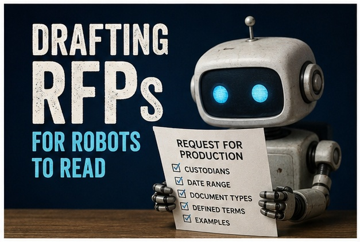
Drafting RFPs for Robots to Read

20 Monday Jul 2026

Posted by craigball in ai, E-Discovery, Law Practice & Procedure

≈ 2 Comments

Tags

ai, artificial-intelligence, chatgpt, discovery, E-Discovery, eDiscovery, ESI Protocols, generative-ai, LLM, Requests for Production, RFP, technology

Time flies: Two years ago, in a post here, I floated the proposition that if the other side is going to hand your requests for production to a large language model and let the machine decide what’s responsive, then let’s draft those requests with the machine in mind. Doug Austin was generous enough to amplify the idea a week later. Two years on, it’s no longer something to merely think about; producing parties are ceding first-pass relevance review to LLMs.  The request in front of the model is now a prompt whether we know it or not.

So, let’s make that prompt our own.

A large language model doesn’t share the experience a seasoned reviewer brings to “all documents touching or concerning the transaction.” Ambiguity that a human reviewer resolves by instinct becomes, for a model, a coin flip between over- and under-inclusion. If you want their AI to find what you need, then tell it how to discriminate.

Seen that way, an AI-aware request for production is doing one of two things. At a minimum, it lards the request with enough discrete elements—custodians, systems, defined terms, date ranges, document types, examples—that opposing counsel can hardly avoid building those elements into whatever prompt they feed their review platform. At best (insofar as the rules of procedure permit or human sloth promotes), it hands them a fully formed prompt: language so ready to roll that the path of least resistance is to paste it straight away. The first mode constrains by specificity; the second exploits the happy truth that a good prompt ready-made is a prompt somebody will be tempted to deploy. Either way, the benefits are the same: clarity over boilerplate, context over conclusion, defined terms over loose keywords, and illustrative examples that let the model pattern-match to the documents you need.

None of this is way out there. It’s just good drafting, made newly consequential because the first reader is now a machine.

Oh, Those Pesky Rules

The Federal Rules reward this technique. FRCP Rule 34(b)(1)(A) requires that a request “describe with reasonable particularity each item or category of items to be inspected.” Particularity and prompt-craft pull on the same oar: both esteem the concrete over the conclusory. An AI-aware request isn’t a departure from Rule 34; it’s Rule 34 taken seriously by a lawyer who recognizes a model is on the other end.

Cautions to Stay Inside the Guardrails

First, drafting a request is not the same as running the other side’s review.  The Sedona Principles, Third Edition, Principle 6, holds that “responding parties are best situated to evaluate the procedures, methodologies, and technologies appropriate for preserving and producing their own electronically stored information.” I’ve quarreled with Sedona Six before—competence is something a producing party should endeavor to earn, not something we should presume—but the principle still rears its ugly head to shield the tools the other side chooses. So, the line to walk is this: an AI-aware request steers relevance and particularity; it does not dictate the responding party’s platform. Write the request to tell the model, any model, what responsiveness looks like. Don’t write it so as to effectively tell opposing counsel which model to choose or how to configure it. The former is advocacy and fair game. The latter invites a well-founded objection.

Second, particularity is a gun that kicks as hard as it shoots. The more precisely we enumerate document types and search terms, the greater the risk that a producing party treats a careful list as the outer boundary of the request and withholds everything beyond it. Two years ago, I noted this language would be “unlikely to be embraced by counsel ever-apprehensive of framing a request too-narrowly,” and the worry remains. The fix is craftsmanship: pair concrete guidance with a stated purpose and, okay, keep your cherished “including but not limited to,” so your examples instruct the model without unduly shrinking the scope.

There’s a third point worth mentioning, because it proves prompts are becoming discovery objects in their own right. In Conservation Law Foundation, Inc. v. Shell Oil Co., No. 3:21-cv-00933 (D. Conn. May 18, 2026), a magistrate judge ordered production of the prompts an expert used to drive an AI tool, treating them as fair game for discovery into methodology. That case concerns an expert’s prompts, not the language of an RFP (and, frankly, I don’t think the judge got it right in the face of a stipulation between the parties); so don’t read too much into it.  Still, the decision signals that courts have started to regard AI prompts as part of the discovery record. The prompt-craft we bring to our requests and the prompts our adversaries feed their review platforms are drifting toward daylight.

How Does It Work?

Take a matter everyone remembers. In the Dominion Voting Systems’ defamation suit against Fox News—the case that settled for $787.5 million in April 2023—the fight turned on what people inside Fox knew about the falsity of the fraud claims their network kept airing. A conventional, human-oriented request in that case might read like this, and requests like it are served every day:

All Documents and Communications relating to Dominion Voting Systems, including any allegation of fraud, vote manipulation, algorithmic “vote switching,” or foreign influence involving Dominion’s products in connection with the November 2020 U.S. presidential election.

Does a senior associate knows what to do with that? An AI model told to sort a Fox custodian’s mailbox against it will drown—everything “relates to” Dominion in a case about Dominion! A fallback to keywords will be, at once, over- and under-inclusive.

Let’s rewrite the request as something a reviewer will be sorely tempted to paste straight into a review tool:

Identify and produce every Document and Communication—including emails, text and Signal messages, Slack messages, on-air scripts, booking notes, and drafts—in which any Fox News host, producer, booker, or executive discussed, doubted, questioned, promoted, or sought to substantiate the claim that Dominion Voting Systems’ machines or software switched, deleted, or altered votes, or were connected to Smartmatic, Venezuela, Hugo Chávez, or the “Kraken.” The purpose of this request is to surface each custodian’s internal knowledge of the truth or falsity of the on-air fraud allegations. Responsive material will typically originate with custodians including the hosts and executives identified in Schedule A, date from November 1, 2020 through the network’s 2021 on-air corrections, and use terms such as “Dominion,” “Powell,” “Giuliani,” “rigged,” “switch,” “Smartmatic,” “Chávez,” or “crazy.” An example of a responsive document is an internal text message in which a host privately derided the fraud claims as baseless while the network continued to air them.

Notice what the second version does and doesn’t do. It gives the model purpose, custodians, boundaries, defined terms, and an example—everything a prompt needs, and enough discrete hooks that the other side can’t build its own prompt without importing most of them. It says nothing about which review platform to buy or how to configure and train it.

Use the Tools

One last point: If we’re going to draft requests for a machine to read, we might as well let a machine do the heavy lifting. Today’s subscription-tier models—the paid versions of ChatGPT, Claude, Gemini, or ChatGPT, not the free tiers coasting on last year’s tech—handle this conversion with ease. Feed one your draft and the bare contours of the case and let it do the heavy lifting. The prompt need be no fancier than this:

You are an experienced litigator revising a request for production so an AI tool conducting first-pass relevance review will read it accurately. Rewrite the request below to add reasonable particularity: name the likely custodians and data sources, add a one-sentence statement of purpose, enumerate the pertinent document types, list the defined terms and search language, set a sensible date range, and give one example of a responsive document—without dictating the responding party’s review methodology or narrowing the request’s reach. Here’s the request: [paste].

As always, mind the confidentiality of whatever you paste, use an account that won’t train on your inputs, and read every word the machine spits back—but let it spare you the first draft.

The robots are reading our requests now. Shouldn’t we write for our real audience?

Share this:

  • Email a link to a friend (Opens in new window) Email
  • Print (Opens in new window) Print
  • Share on X (Opens in new window) X
  • Share on Facebook (Opens in new window) Facebook
  • Share on LinkedIn (Opens in new window) LinkedIn
Like Loading...

Detecting Deep Fakes

24 Tuesday Feb 2026

Posted by craigball in ai, Computer Forensics, E-Discovery, General Technology Posts, Law Practice & Procedure

≈ 2 Comments

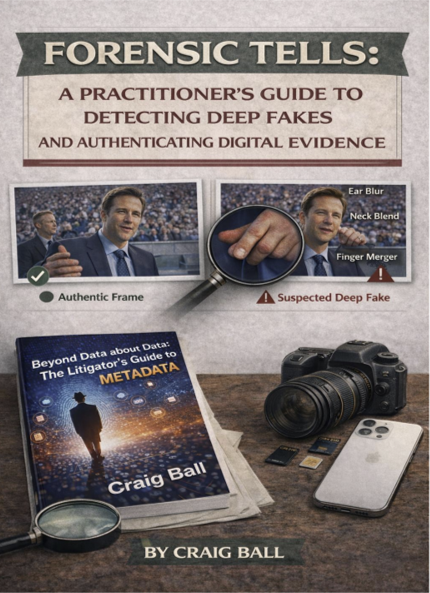
This morning, I was approached to present in Texas on deep fake evidence and what litigators need to know to confront it.  It’s to be called, “Real or Rigged: How to Know Whether Evidence Is Fake.” I realized, to my chagrin, that I didn’t have a paper I could hand out—no single place where I had pulled together the technical realities, evidentiary doctrine, and practical litigation tactics this subject demands. So, I wrote one. Whether I ultimately give the talk remains to be seen, but I’m hopeful the resulting article will prove useful to you. The paper—Forensic Tells: A Practitioner’s Guide to Detecting Deep Fakes and Authenticating Digital Evidence—runs about thirty pages and is available here.

The piece starts from a simple premise: digital evidence does not fall like manna from heaven; it has a provenance that speaks to its authenticity. It is fundamentally different from paper because it carries a payload of information about its origins and handling—metadata that functions as a chain of custody embedded within the file itself. In an era when AI systems can generate convincing photographs, videos, and audio recordings of events that never occurred, that metadata has become the last line of defense against manufactured reality.

While I regard myself as much more a student of AI than an authority, I’ve been writing about metadata and evidence as long as anyone on two legs; so, I hope I bring something of value to the topic.  You be the judge.  The article explains, in practical terms, how synthetic media is created, why fabricated media often lacks the coherent metadata of authentic recordings, and how lawyers can use that disparity to authenticate—or challenge—digital evidence. It also addresses the emerging “liar’s dividend,” the phenomenon whereby wrongdoers dismiss authentic recordings as fake simply because the technology exists to fabricate them.

More importantly, the article is written as a practitioner’s guide, not a technical treatise. It outlines concrete discovery strategies: demanding native files, targeting interrogatories and requests for admission, pursuing third-party records, and, where necessary, seeking forensic examination of source devices. It explains what to look for in metadata, what visual and auditory artifacts may signal manipulation, and how federal and Texas evidence rules—including Rules 901 and 902—apply to synthetic media challenges. It closes with a practical checklist and discussion of emerging provenance technologies that may someday make authentication easier—but, for now, make it more essential that lawyers understand how to ask the right questions.

Your feedback is always welcome and appreciated.

Share this:

  • Email a link to a friend (Opens in new window) Email
  • Print (Opens in new window) Print
  • Share on X (Opens in new window) X
  • Share on Facebook (Opens in new window) Facebook
  • Share on LinkedIn (Opens in new window) LinkedIn
Like Loading...

A Master Table of Truth

04 Tuesday Nov 2025

Posted by craigball in ai, Computer Forensics, E-Discovery, General Technology Posts, Law Practice & Procedure, Uncategorized

≈ 5 Comments

Tags

ai, artificial-intelligence, chatgpt, eDiscovery, generative-ai, law, technology

Lawyers using AI keep turning up in the news for all the wrong reasons—usually because they filed a brief brimming with cases that don’t exist. The machines didn’t mean to lie. They just did what they’re built to do: write convincingly, not truthfully.

When you ask a large language model (LLM) for cases, it doesn’t search a trustworthy database. It invents one. The result looks fine until a human judge, an opponent or an intern with Westlaw access, checks. That’s when fantasy law meets federal fact.

We call these fictions “hallucinations,” which is a polite way of saying “making shit up;” and though lawyers are duty-bound to catch them before they reach the docket, some don’t. The combination of an approaching deadline and a confident-sounding computer is a dangerous mix.

Perhaps a Useful Guardrail

It struck me recently that the legal profession could borrow a page from the digital forensics world, where we maintain something called the NIST National Software Reference Library (NIST NSRL). The NSRL is a public database of hash values for known software files. When a forensic examiner analyzes a drive, the NSRL helps them skip over familiar system files—Windows dlls and friends—so they can focus on what’s unique or suspicious.

So here’s a thought: what if we had a master table of genuine case citations—a kind of NSRL for case citations?

Picture a big, continually updated, publicly accessible table listing every bona fide reported decision: the case name, reporter, volume, page, court, and year. When your LLM produces Smith v. Jones, 123 F.3d 456 (9th Cir. 2005), your drafting software checks that citation against the table.

If it’s there, fine—it’s probably references a genuine reported case.
If it’s not, flag it for immediate scrutiny.

Think of it as a checksum for truth. A simple way to catch the most common and indefensible kind of AI mischief before it becomes Exhibit A at a disciplinary hearing.

The Obstacles (and There Are Some)

Of course, every neat idea turns messy the moment you try to build it.

Coverage is the first challenge. There are millions of decisions, with new ones arriving daily. Some are published, some are “unpublished” but still precedential, and some live only in online databases. Even if we limited the scope to federal and state appellate courts, keeping the table comprehensive and current would be an unending job; but not an insurmountable obstacle.

Then there’s variation. Lawyers can’t agree on how to cite the same case twice. The same opinion might appear in multiple reporters, each with its own abbreviation. A master table would have to normalize all of that—an ambitious act of citation herding.

And parsing is no small matter. AI tools are notoriously careless about punctuation. A missing comma or swapped parenthesis can turn a real case into a false negative. Conversely, a hallucinated citation that happens to fit a valid pattern could fool the filter, which is why it’s not the sole filter.

Lastly, governance. Who would maintain the thing? Westlaw and Lexis maintain comprehensive citation data, but guard it like Fort Knox. Open projects such as the Caselaw Access Project and the Free Law Project’s CourtListener come close, but they’re not quite designed for this kind of validation task. To make it work, we’d need institutional commitment—perhaps from NIST, the Library of Congress, or a consortium of law libraries—to set standards and keep it alive.

Why Bother?

Because LLMs aren’t going away. Lawyers will keep using them, openly or in secret. The question isn’t whether we’ll use them—it’s how safely and responsibly we can do so.

A public master table of citations could serve as a quiet safeguard in every AI-assisted drafting environment. The AI could automatically check every citation against that canonical list. It wouldn’t guarantee correctness, but it would dramatically reduce the risk of citing fiction. Not coincidentally, it would have prevented most of the public excoriation of careless counsel we’ve seen.

Even a limited version—a federal table, or one covering each state’s highest court—would be progress. Universities, courts, and vendors could all contribute. Every small improvement to verifiability helps keep the profession credible in an era of AI slop, sloppiness and deep fakes.

No Magic Bullet, but a Sensible Shield

Let’s be clear: a master table won’t prevent all hallucinations. A model could still misstate what a case holds, or cite a genuine decision for the wrong proposition. But it would at least help keep the completely fabricated ones from slipping through unchecked.

In forensics, we accept imperfect tools because they narrow uncertainty. This could do the same for AI-drafted legal writing—a simple checksum for reality in a profession that can’t afford to lose touch with it.

If we can build databases to flag counterfeit currency and pirated software, surely we can build one to spot counterfeit law?

Until that day, let’s agree on one ironclad proposition: if you didn’t verify it, don’t file it.

Share this:

  • Email a link to a friend (Opens in new window) Email
  • Print (Opens in new window) Print
  • Share on X (Opens in new window) X
  • Share on Facebook (Opens in new window) Facebook
  • Share on LinkedIn (Opens in new window) LinkedIn
Like Loading...

Native or Not? Rethinking Public E-Mail Corpora for E-Discovery (Redux, 2013→2025)

16 Saturday Aug 2025

Posted by craigball in ai, Computer Forensics, E-Discovery, Uncategorized

≈ 2 Comments

Tags

ai, artificial-intelligence, chatgpt, eDiscovery, EDRM, generative-ai, Linked attachments, Purview, technology

Yesterday, I found myself in a spirited exchange with a colleague about whether the e-discovery community has suitable replacements for the Enron e-mail corpora1—now more than two decades old—as a “sandbox” for testing tools and training students. I argued that the quality of the data matters: native or near-native e-mail collections remain essential to test processing and review workflows in ways that mirror real-world litigation.

The back-and-forth reminded me that, unlike forensic examiners or service providers, ediscovery lawyers may not know or care much about the nature of electronically-stored information until it finds its way to a review tool. I get that. If your interest in email is in testing AI coding tools, you’re laser-focused on text and maybe a handful of metadata; but if your focus is on the integrity and authenticity of evidence, or in perfecting processing tools, the originating native or near-native form of the corpus matters more.

What follows is a re-publication of a post from July 2013. I’m bringing it back because the debate over forms of email hasn’t gone away; the issue is as persistent and important as ever. A central takeaway bears repeating: the litmus test is whether a corpus hews to a fulsome RFC-5322 compliant format. If headers, MIME boundaries, and transport artifacts are stripped or incompletely synthesized, what remains ceases to be a faithful native or near-native format. That distinction matters, because even experienced e-discovery practitioners—those fixated on review at the far-right side of the EDRM—may not fully appreciate what an RFC-5322 email is, or how much fidelity is lost when working with post-processed sets.

Continue reading →

Share this:

  • Email a link to a friend (Opens in new window) Email
  • Print (Opens in new window) Print
  • Share on X (Opens in new window) X
  • Share on Facebook (Opens in new window) Facebook
  • Share on LinkedIn (Opens in new window) LinkedIn
Like Loading...

Chambers Guidance: Using AI Large Language Models (LLMs) Wisely and Ethically

19 Thursday Jun 2025

Posted by craigball in ai, General Technology Posts, Law Practice & Procedure

≈ 3 Comments

Tags

ai, artificial-intelligence, chatgpt, generative-ai, law, LLM, technology

Tomorrow, I’m delivering a talk to the Texas Second Court of Appeals (Fort Worth), joined by my friend, Lynne Liberato of Houston. We will address LLM use in chambers and in support of appellate practice, where Lynne is a noted authority. I’ll distribute my 2025 primer on Practical Uses for AI and LLMs in Trial Practice, but will also offer something bespoke to the needs of appellate judges and their legal staff–something to-the-point but with cautions crafted to avoid the high profile pitfalls of lawyers who trust but don’t verify.

Courts must develop practical internal standards for the use of LLMs in chambers. These AI applications are too powerful to ignore and too powerful to use without attention given to safe use.

Chambers Guidance: Using AI Large Language Models (LLMs) Wisely and Ethically

Prepared for Second District Court of Appeals (Fort Worth)


Purpose
This document outlines recommended practices for the safe, productive, and ethical use of large language models (LLMs) like ChatGPT-4o in chambers by justices and their legal staff.


I. Core Principles

  1. Human Oversight is Essential
    LLMs may assist with writing, summarization, and idea generation, but should never replace legal reasoning, human editing, or authoritative research.
  2. Confidentiality Must Be Preserved
    Use only secure platforms. Turn off model training/sharing features (“model improvement”) in public platforms or use private/local deployments.
  3. Verification is Non-Negotiable
    Never rely on an LLM for case citations, procedural rules, or holdings without confirming them via Westlaw, Lexis, or court databases.  Every citation is suspect until verified.
  4. Transparency Within Chambers
    Staff should disclose when LLMs were used in a draft or summary, especially if content was heavily generated.  Prompt/output history should be preserved in chambers files.
  5. Judicial Independence and Public Trust
    While internal LLM use may be efficient, it must never undermine public confidence in the independence or impartiality of judicial decision-making. The use of LLMs must not give rise to a perception that core judicial functions have been outsourced to AI.

II. Suitable Uses of LLMs in Chambers

  • Drafting initial outlines of bench memos or summaries of briefs
  • Rewriting judicial prose for clarity, tone, or readability
  • Summarizing long records or extracting procedural chronologies
  • Brainstorming counterarguments or exploring alternative framings
  • Comparing argumentative strength and inconsistencies of and between parties’ briefs

Note: Use of AI output that may materially influence a decision must be identified and reviewed by the judge or supervising attorney.


III. Prohibited or Cautioned Uses

  • Do not insert any LLM-generated citation into a judicial order, opinion, or memo without independent confirmation
  • Do not input sealed or sensitive documents into unsecured platforms
  • Do not use LLMs to weigh legal precedent, assess credibility, or determine binding authority
  • Do not delegate critical judgment or reasoning tasks to the model (e.g., weighing precedent or evaluating credibility)
  • Do not rely on LLMs to generate summaries of legal holdings without human review of the supporting authority

IV. Suggested Prompts for Effective Use

These prompts may be useful when paired with careful human oversight and verification

  • “Summarize this 40-page brief into 5 bullet points, focusing on procedural history.”
  • “Summarize the uploaded transcript respecting the following points….”
  • “Summarize the key holdings and the law in this area”
  • “Rewrite this paragraph for clarity, suitable for a published opinion.”
  • “List potential counterarguments to this position in a Texas appellate context.”
  • “Explain this concept as if to a first-year law student.”

Caution: Prompts seeking legal summaries (e.g., “What is the holding of X?” or “Summarize the law on Y”) are particularly prone to error and must be treated with suspicion. Always verify output against primary legal sources.


V. Public Disclosure and Transparency

Although internal use of LLMs may not require disclosure to parties, courts must be sensitive to the risk that judicial reliance on AI—even as a drafting aid—may be scrutinized. Consider whether and what disclosure may be warranted in rare cases when LLM-generated language substantively shapes a judicial decision.

VI. Final Note

Used wisely, LLMs can save time, increase clarity, and prompt critical thought. Used blindly, they risk error, overreliance, or breach of confidentiality. The justice system demands precision; LLMs can support it—but only under a lawyer’s and judge’s careful eye and hand.


Prepared by Craig Ball and Lynne Liberato, advocating thoughtful AI use in appellate practice.

Of course, the proper arbiters of standards and practices in chambers are the justices themselves; I don’t presume to know better, save to say that any approach that bans LLMs or presupposes AI won’t be used is naive. I hope the modest suggestions above help courts develop sound practical guidance for use of LLMs by judges and staff in ways that promote justice, efficiency and public confidence.

Share this:

  • Email a link to a friend (Opens in new window) Email
  • Print (Opens in new window) Print
  • Share on X (Opens in new window) X
  • Share on Facebook (Opens in new window) Facebook
  • Share on LinkedIn (Opens in new window) LinkedIn
Like Loading...
Follow Ball in your Court on WordPress.com

Enter your email address to subscribe to this blog and receive notifications of new posts by email.

Join 2,241 other subscribers

Recent Posts

  • Fifteen Years in Your Court August 21, 2026
  • The AI Protective Order Double Standard July 27, 2026
  • Drafting RFPs for Robots to Read July 20, 2026
  • A Refresh of the Annotated ESI Protocol May 1, 2026
  • Free at Last: Ditching TurboTax for FreeTaxUSA April 5, 2026

Archives

RSS Feed RSS - Posts

CRAIGBALL.COM

Categories

EDD Blogroll

  • Illuminating eDiscovery (Lighthouse)
  • Complex Discovery (Rob Robinson)
  • eDiscovery Journal (Greg Buckles)
  • Basics of E-Discovery (Exterro)
  • eDiscovery Today (Doug Austin)
  • Corporate E-Discovery Blog (Zapproved )
  • CS DISCO Blog
  • GLTC (Tom O'Connor)
  • E-Discovery Law Alert (Gibbons)
  • E-D Team (Ralph Losey)
  • Sedona Conference
  • The Relativity Blog
  • Minerva 26 (Kelly Twigger)

Admin

  • Create account
  • Log in
  • Entries feed
  • Comments feed
  • WordPress.com

Enter your email address to follow Ball in Your Court and receive notifications of new posts by email.

Website Powered by WordPress.com.

  • Subscribe Subscribed
    • Ball in your Court
    • Join 2,093 other subscribers
    • Already have a WordPress.com account? Log in now.
    • Ball in your Court
    • Subscribe Subscribed
    • Sign up
    • Log in
    • Report this content
    • View site in Reader
    • Manage subscriptions
    • Collapse this bar
Loading Comments...
%d