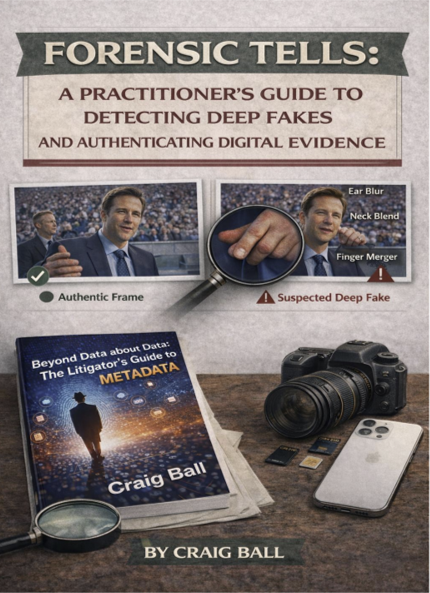
This morning, I was approached to present in Texas on deep fake evidence and what litigators need to know to confront it. It’s to be called, “Real or Rigged: How to Know Whether Evidence Is Fake.” I realized, to my chagrin, that I didn’t have a paper I could hand out—no single place where I had pulled together the technical realities, evidentiary doctrine, and practical litigation tactics this subject demands. So, I wrote one. Whether I ultimately give the talk remains to be seen, but I’m hopeful the resulting article will prove useful to you. The paper—Forensic Tells: A Practitioner’s Guide to Detecting Deep Fakes and Authenticating Digital Evidence—runs about thirty pages and is available here.
The piece starts from a simple premise: digital evidence does not fall like manna from heaven; it has a provenance that speaks to its authenticity. It is fundamentally different from paper because it carries a payload of information about its origins and handling—metadata that functions as a chain of custody embedded within the file itself. In an era when AI systems can generate convincing photographs, videos, and audio recordings of events that never occurred, that metadata has become the last line of defense against manufactured reality.
While I regard myself as much more a student of AI than an authority, I’ve been writing about metadata and evidence as long as anyone on two legs; so, I hope I bring something of value to the topic. You be the judge. The article explains, in practical terms, how synthetic media is created, why fabricated media often lacks the coherent metadata of authentic recordings, and how lawyers can use that disparity to authenticate—or challenge—digital evidence. It also addresses the emerging “liar’s dividend,” the phenomenon whereby wrongdoers dismiss authentic recordings as fake simply because the technology exists to fabricate them.
More importantly, the article is written as a practitioner’s guide, not a technical treatise. It outlines concrete discovery strategies: demanding native files, targeting interrogatories and requests for admission, pursuing third-party records, and, where necessary, seeking forensic examination of source devices. It explains what to look for in metadata, what visual and auditory artifacts may signal manipulation, and how federal and Texas evidence rules—including Rules 901 and 902—apply to synthetic media challenges. It closes with a practical checklist and discussion of emerging provenance technologies that may someday make authentication easier—but, for now, make it more essential that lawyers understand how to ask the right questions.
Your feedback is always welcome and appreciated.
 Ball in your Court
Pingback: A Practitioner’s Guide to Detecting Deep Fakes and Authenticating Digital Evidence
Pingback: Week 09 – 2026 – This Week In 4n6