
• Home
  • About
  • CRAIGBALL.COM
  • Disclaimer
  • Log In

Ball in your Court

~ Musings on e-discovery & forensics.

Ball in your Court

Category Archives: E-Discovery

Proof Finder Hits Philanthropic Goal

25 Tuesday Jun 2013

Posted by craigball in Computer Forensics, E-Discovery, General Technology Posts

≈ Comments Off on Proof Finder Hits Philanthropic Goal

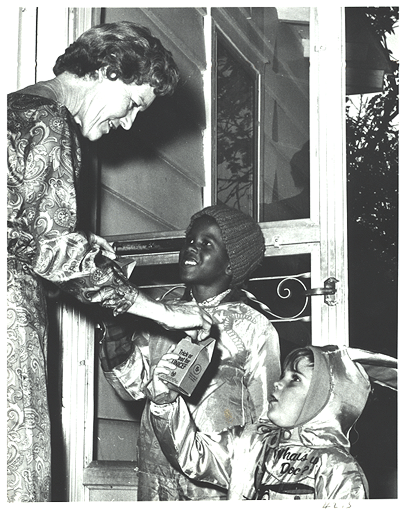
unicef3When I was a boy, in that innocent time before poisoned Pixy Stix, Halloween was magical.  We planned our costumes for months and mapped routes to maximize candy yields.  But it wasn’t all Batman and Casper and treats.  We also turned our milk cartons into piggy banks and cried “Trick or Treat for UNICEF” at every door  A few pennies collected with Chuckles and Charms bought a month’s worth of milk for a hungry child.  Then as now, so little could do so much to aid needy children a world away.  I’m reminded of that as I share the wonderful news that Nuix has reached its goal to raise $100,000 for charity by selling licenses for Proof Finder.

My friend Eddie Sheehy, CEO of Nuix, announced today that, “To date, Proof Finder sales have helped Room to Read and local communities build schools in Nepal and Sri Lanka, publish local-language school books and provide support for 30 girls to complete secondary education. With the funds raised since March 2013, Room to Read will establish two libraries in Delhi, India and provide a full year of secondary school education for 20 girls in India.” Continue reading →
Share this:

  • Email a link to a friend (Opens in new window) Email
  • Print (Opens in new window) Print
  • Share on X (Opens in new window) X
  • Share on Facebook (Opens in new window) Facebook
  • Share on LinkedIn (Opens in new window) LinkedIn
Like Loading...

Dogged Pursuit of Direct Access Poses Risks to Counsel

22 Saturday Jun 2013

Posted by craigball in E-Discovery

≈ 1 Comment

No One KnowsIn any plaintiff’s case, the claimant is Exhibit A.  A claimant must be credible because, where the number of lies a jury allows a defendant varies from case to case; the person suing for money gets none.  One reason I liked trying wrongful death cases was that the victim couldn’t testify.

A common way to prove a claimant isn’t credible is by proving the claimant tells different stories about matters made the basis of the suit.  Such “prior inconsistent statements” are excluded from the rule against using hearsay testimony, not just as an exception to the rule but by being defined as “not hearsay.”[1]  So, if a defendant can lay hands on such statements, the statements are coming into evidence and may really hurt.

Nowadays, many prior inconsistent statements are found on social networking sites like Facebook, LinkedIn and Twitter.  Facebook posts and tweets with tales of actions and attitudes at odds with claims in court are splendid fodder for impeachment.  Even a Facebook photo of a claimant with a smile may serve as ammo for impeachment when mental anguish damages are sought. Continue reading →

Share this:

  • Email a link to a friend (Opens in new window) Email
  • Print (Opens in new window) Print
  • Share on X (Opens in new window) X
  • Share on Facebook (Opens in new window) Facebook
  • Share on LinkedIn (Opens in new window) LinkedIn
Like Loading...

The ‘Not Me’ Factor

17 Monday Jun 2013

Posted by craigball in E-Discovery

≈ 13 Comments

Not MeI’ve been skeptical of predictive coding for years, even before I wrote my first column on it back in 2005.  Like most, I was reluctant to accept that a lifeless mass of chips and wires could replicate the deep insight, the nuanced understanding, the sheer freaking brilliance that my massive lawyer brain brings to discovery.  Wasn’t I the guy who could pull down that one dusty box in a cavernous records repository and find the smoking gun everyone else overlooked?  Wasn’t it my rarefied ability to discern the meaning lurking beneath the bare words that helped win all those verdicts? 

Well, no, not really.  But, I still didn’t trust software to make the sort of fine distinctions I thought assessing relevance required. Continue reading →

Share this:

  • Email a link to a friend (Opens in new window) Email
  • Print (Opens in new window) Print
  • Share on X (Opens in new window) X
  • Share on Facebook (Opens in new window) Facebook
  • Share on LinkedIn (Opens in new window) LinkedIn
Like Loading...

Amendments Should Safeguard Meta-Discovery

09 Sunday Jun 2013

Posted by craigball in E-Discovery

≈ 6 Comments

metadata_awareness_ribbon“American laws and American policy view the content of communications as the most private and the most valuable, but that is backwards today,” said Marc Rotenberg, the executive director of the Electronic Privacy Information Center, a Washington group. “The information associated with communications today is often more significant than the communications itself, and the people who do the data mining know that.”  
How the U.S. Uses Technology to Mine More Data More Quickly
, New York Times, June 8, 2013

Marc Rotenberg was commenting on the recent revelation that the U.S. National Security Agency gathers a staggering volume of information about domestic and international telephone calls.  When he states, “The information associated with communications today is often more significant than the communications itself…,” he doesn’t expressly label that “more significant” information as being “metadata,” but that’s what it is.

Rotenberg’s right: metadata matters. Continue reading →

Share this:

  • Email a link to a friend (Opens in new window) Email
  • Print (Opens in new window) Print
  • Share on X (Opens in new window) X
  • Share on Facebook (Opens in new window) Facebook
  • Share on LinkedIn (Opens in new window) LinkedIn
Like Loading...

The Real Voyage of E-Discovery

25 Saturday May 2013

Posted by craigball in Computer Forensics, E-Discovery

≈ 1 Comment

The real voyage of discovery consists not in seeking new landscapes, but in having new eyes. – Marcel Proust

eye

E-discovery education is lawyers and judges teaching lawyers and judges the law of discovery, but little of the “e.”  This closed loop is unhealthy because it reinforces the misperception that understanding what makes digital different doesn’t matter.

But, of course it does.  

It’s human nature to set the standards for competence so that you meet them. No one wants to define themselves out of a job.  As a result, the trial bar keeps telling itself that grasping the bits and bytes of information technology is someone else’s problem…or not a problem.  “The top lawyers and judges out there don’t know that stuff, so it can’t be something a lawyer or judge needs to know.”  That’s the view through old eyes.

I dump on lawyers for ducking the obligation to to be competent in a world teeming with electronic evidence.  But I recognize that even the brave souls that try to cultivate new eyes for digital evidence are confounded by the paucity of e-discovery instruction affording equal stature to the technology.  Where do lawyers learn the very thing that makes e-discovery so daunting for them?  Where do they learn it in the unique context of trial practice and put their newfound skills into practice?

Right now, there’s probably only one answer to those questions: the Georgetown E-Discovery Training Academy, a weeklong program offered in early June, with the next Academy starting on June 2nd. Continue reading →

Share this:

  • Email a link to a friend (Opens in new window) Email
  • Print (Opens in new window) Print
  • Share on X (Opens in new window) X
  • Share on Facebook (Opens in new window) Facebook
  • Share on LinkedIn (Opens in new window) LinkedIn
Like Loading...

Prooffinder: Touch the Monolith

09 Thursday May 2013

Posted by craigball in Computer Forensics, E-Discovery

≈ 3 Comments

Prooffinder_evolveIn the spring of 1968, my sixth grade class from suburban Eastchester went to the Loews Capitol Theatre at 51st and Broadway in New York City to see 2001: A Space Odyssey.  It was an unforgettable event.  Though much of the movie went over our ten-year-old heads, we got the message about tools and evolution when our hairy forebear flung his bone “hammer” aloft and it became a sleek spaceship.  We evolve to use tools, and the tools we use drive our evolution.

We can’t deal with electronic evidence without tools.  The more adept we are with those tools, the more adept we become with electronic evidence.  Tools that let us touch data—hold it up to the light and turn it this way and that—change the way we look at data.  Tools change us.

 I’m always preaching that lawyers must get their hands dirty with data and get back in touch with the evidence.  It’s a metaphor, but it’s also a manifesto.  A master builder needn’t swing every hammer; but, a master builder knows how a hammer feels in the hand. Continue reading →

Share this:

  • Email a link to a friend (Opens in new window) Email
  • Print (Opens in new window) Print
  • Share on X (Opens in new window) X
  • Share on Facebook (Opens in new window) Facebook
  • Share on LinkedIn (Opens in new window) LinkedIn
Like Loading...

When Do You Buy T-Shirts?

27 Wednesday Mar 2013

Posted by craigball in E-Discovery

≈ 6 Comments

choirI did an ILTA webcast this morning called “Going Native.” Steven Clark ably moderated the panel including Denise Talbert and Maureen Holland.  D4 sponsored.  Going Native did not mean we spoke in loincloths (although I can really only account for my own attire).  We addressed the pros and cons of producing ESI in native and near native forms versus conversion from native forms to TIFF images and load files.  I expected agressive pushback as I sang the praises (Just! Speedy! Inexpensive!) of native productions; but, steeled for debate, I was instead treated to fine dialog.  No one trotted out the usual hackneyed objections to native productions.  Advantages and disadvantages were thoughtfully addressed and everyone proved open to flexibility in forms of productions when to do so serves to meet a genuine need or solve a problem.

When polled, roughly half of those attending stated that they weren’t making production in native and near-native forms simply because the requesting parties hadn’t sought same.  Around 16% said they resisted native production out of concern that native productions were harder to track.  My sense is that the attendees were open–even eager–to embrace native production.  I wasn’t surprised by this because there are few audiences for e-discovery education as sophisticated and rational as ILTA audiences.  ILTA members tend to be hands on with ESI, affording them a better appreciation of the downsides of image and load file productions.  They’re typically the ones tasked with cleaning up the messes caused by malformed load files and TIFF creation errors.

That 16% missing out on the advantages of native productions out of concern that native files aren’t Bates stamped on each page distresses me because I’m sure they correspond to a much larger percentage of lawyers who can’t conceive of litigating without Bates numbers (and protective legends) on every page. It seems a lot of people don’t realize that you don’t have to give up Bates numbers and protective legends when you make native productions.  If you approach native productions the right way, the Bates numbers will still be there when you need them.  I’ll explain how that works, but first please indulge me in a little mental exercise. Continue reading →

Share this:

  • Email a link to a friend (Opens in new window) Email
  • Print (Opens in new window) Print
  • Share on X (Opens in new window) X
  • Share on Facebook (Opens in new window) Facebook
  • Share on LinkedIn (Opens in new window) LinkedIn
Like Loading...

Cleary Counsels Clarity: Steps to Better Requests and Responses in Discovery

25 Monday Mar 2013

Posted by craigball in E-Discovery

≈ 3 Comments

GropingA colleague flagged an opinion from the Northern District of Oklahoma she’d seen blogged on a big firm website. In the decision, the judge spoke dismissively of “apps” that must be responsible for those hairballs so common in discovery: vague requests and objection-obscured replies.  The blogger took the judge’s mention of apps too-literally, even noting that the judge failed to name the offending software.

I suspect those literary devices called irony and satire may have been lost on the blogger.  The court in Howard v. Segway, Inc. wasn’t saying both sides had actually used bad apps; instead, Magistrate Judge Paul J. Cleary was referencing the current fervor for apps metaphorically, as a means to convey that the more things change, the more they stay the same.  That is, whether you slavishly draw boilerplate from a paper form or program the same mindless twaddle into a document assembly app on your iPad, drivel remains drivel, and obstruction invites sanctions. Continue reading →

Share this:

  • Email a link to a friend (Opens in new window) Email
  • Print (Opens in new window) Print
  • Share on X (Opens in new window) X
  • Share on Facebook (Opens in new window) Facebook
  • Share on LinkedIn (Opens in new window) LinkedIn
Like Loading...

Are Documents Containing Agreed-Upon Keywords Responsive Per Se?

22 Friday Mar 2013

Posted by craigball in E-Discovery

≈ 8 Comments

More than once, I’ve faced disputes stemming from diametrically different expectations concerning the use of keywords as a means to identify responsive ESI.  I don’t recall seeing a case on this; but, it wouldn’t surprise me if there was one.  If not, there soon will be because the issue is more common than one might imagine.

When requesting parties hammer out agreements on search terms to be run against the producing party’s ESI, sometimes the requesting party’s expectation is that any item responsive to the agreed-upon keywords (that is, any item that’s “hit”) must be produced unless withheld as privileged.  Put another way, the requesting party believes that, by agreeing to the use of a set of keywords as a proxy for attorney review of the entire potentially-responsive collection, and thereby relieving the producing party of the broader obligation to look at everything that may be responsive, those keywords define responsiveness per se, requiring production if not privileged. Continue reading →

Share this:

  • Email a link to a friend (Opens in new window) Email
  • Print (Opens in new window) Print
  • Share on X (Opens in new window) X
  • Share on Facebook (Opens in new window) Facebook
  • Share on LinkedIn (Opens in new window) LinkedIn
Like Loading...

Eight Tips to Quash the Cost of E-Discovery

21 Thursday Mar 2013

Posted by craigball in E-Discovery

≈ 23 Comments

8 tips[If this post seems a bit more basic than my usual in-the-weeds blather, it’s because this is taken from a CLE article I wrote for an upcoming panel discussion on “E-Discovery on a Budget.”  I’m particularly pleased with tips 7 and 8, and hope you’ll please share some of your own tips as comments.]

This really happened:
Opposing counsel supplied an affidavit stating it would take thirteen years to review 33 months of e-mail traffic for thirteen people.  Counsel averred there would be about 950,000 messages and attachments after keyword filtering.  Working all day, every day reviewing 40 documents per hour, they expected first level review to wrap up in 23,750 hours.  A more deliberate second level review of 10-15% of the items would require an additional two years.  Finally, counsel projected another year to prepare a privilege log.  Cost: millions of dollars.

The arithmetic was unassailable, and a partner in a prestigious law firm swore to its truth under oath. Continue reading →

Share this:

  • Email a link to a friend (Opens in new window) Email
  • Print (Opens in new window) Print
  • Share on X (Opens in new window) X
  • Share on Facebook (Opens in new window) Facebook
  • Share on LinkedIn (Opens in new window) LinkedIn
Like Loading...
← Older posts
Newer posts →
Follow Ball in your Court on WordPress.com

Enter your email address to subscribe to this blog and receive notifications of new posts by email.

Join 2,238 other subscribers

Recent Posts

  • Detecting Deep Fakes February 24, 2026
  • A Fun Way to Build AI Fluency February 21, 2026
  • Electronic Evidence Workbook 2026 February 18, 2026
  • The Most Important Thing I’ve Read This Year February 12, 2026
  • 2026 Guide to AI and LLMs in Trial Practice January 9, 2026

Archives

RSS Feed RSS - Posts

CRAIGBALL.COM

Helping lawyers master technology

Categories

EDD Blogroll

  • E-Discovery Law Alert (Gibbons)
  • Corporate E-Discovery Blog (Zapproved )
  • Illuminating eDiscovery (Lighthouse)
  • eDiscovery Journal (Greg Buckles)
  • Minerva 26 (Kelly Twigger)
  • Complex Discovery (Rob Robinson)
  • Basics of E-Discovery (Exterro)
  • GLTC (Tom O'Connor)
  • The Relativity Blog
  • Sedona Conference
  • E-D Team (Ralph Losey)
  • CS DISCO Blog
  • eDiscovery Today (Doug Austin)

Admin

  • Create account
  • Log in
  • Entries feed
  • Comments feed
  • WordPress.com

Enter your email address to follow Ball in Your Court and receive notifications of new posts by email.

Website Powered by WordPress.com.

  • Subscribe Subscribed
    • Ball in your Court
    • Join 2,090 other subscribers
    • Already have a WordPress.com account? Log in now.
    • Ball in your Court
    • Subscribe Subscribed
    • Sign up
    • Log in
    • Report this content
    • View site in Reader
    • Manage subscriptions
    • Collapse this bar
 

Loading Comments...
 

    %d