Next month, I’m privileged to be presenting on two topics with United States District Judge Xavier Rodriguez, a dear friend who sits in the Western District of Texas (San Antonio). One of those topics is “Practical Applications for AI.” The longstanding custom for continuing legal education in Texas is that a presenter must offer “high quality written materials” to go with a talk. I’m indebted to this obligation because writing is hard work and without the need to supply original scholarship, I’d probably have produced a fraction of what I’ve published over forty years. A new topic meant a new paper, especially as I was the proponent of the topic in the planning stage–an ask borne of frustration. After two years of AI pushing everything else aside, I was frustrated by the dearth of practical guidance available to trial lawyers–particularly seasoned elders–who want to use AI but fear looking foolish…or worse. So, I took a shot at a practical primer for litigators and am reasonably pleased with the result. Download it here. For some it will be too advanced and for others too basic; but I’m hopeful it hits the sweet spot for many non-technical trial lawyers who don’t want to be left behind.
Despite high-profile instances of lawyers getting into trouble by failing to use LLMs responsibly, there’s a compelling case for using AI in your trial practice now, even if only as a timesaver in document generation and summarization—tasks where AI’s abilities are uncanny and undeniable. But HOW to get started?
The Litigation Section of the State Bar of Texas devoted the Winter 2024 issue of The Advocate magazine to Artificial Intelligence. Every article was well-written and well-informed—several penned by close friends—but no article, not one, was practical in the sense of helping lawyers use AI in their work. That struck me as an unmet need.
As I looked around, I found no articles geared to guiding trial lawyers who want to use LLMs safely and strategically. I wanted to call the article “The Leery Lawyer’s Guide to AI,” but I knew it would be insufficiently comprehensive. Instead, I’ve sought to help readers get started by highlighting important considerations and illustrating a few applications that they can try now with minimal skill, anxiety or expense. LLMs won’t replace professional judgment, but they can frame issues, suggest language, and break down complex doctrines into plain English explanations. In truth, they can do just about anything that a mastery of facts and language can achieve.
But Know This…
LLMs are unlike any tech tool you’ve used before. Most of the digital technology in our lives is characterized by consistency: you put the same things in, and other things come out in a rigid and replicable fashion. Not so with LLMs. Ask ChatGPT the same question multiple times, and you’ll get a somewhat different answer each time. That takes getting used to.
Additionally, there’s no single “right” way to interrogate ChatGPT to be assured of an optimal result. That is, there is no strict programming language or set of keywords calculated to achieve a goal. There are a myriad number of ways to successfully elicit information from ChatGPT, and in stark contrast to the inflexible and unforgiving tech tools of the past, the easiest way to get the results you want is to interact with ChatGPT in a natural, conversational fashion.
A friend shared that she was seeing the Carole King musical, “Beautiful,” and I recalled the time I caught it twice on different visits to London in 2015 because I enjoyed it so. I reflected on why I was in London in Summer nine years ago and came across a post from the time–a post that I liked well-enough to revisit it below. I predicted the emergence of the e-savvy opponent, something that has indeed come to pass, yet less-widely or -effectively than I’d hoped (and still hope for). A new generation of e-discoverers has emerged since, so perhaps the post will be fresh (and remain relevant) for more than a few, and sufficiently forgotten to feel fresh for the rest:
(From May 12, 2015): I am in Great Britain this week addressing an E-Discovery and Information Governance conclave, joined by esteemed American colleagues and friends, Jason Baron and Ralph Losey among other luminaries. My keynote topic opening the conference is Girding for the E-Savvy Opponent. Here is a smattering of what I expect to say.
I arrived in London from Budapest in time to catch some of the events for the 70th anniversary of VE Day, marking the hard-won victory over Germany in the war that shortly followed the war that was to have ended all wars.
As we sported poppies and stood solemnly at the Cenotaph recalling the sacrifices made by our parents and grandparents, I mulled technology’s role in battle, and the disasters that come from being unprepared for a tech-savvy opponent.
It’s said that, “Generals are always prepared to fight the last war.” This speaks as much to technology as to tactics. Mounted cavalry proved no match for armored tanks. Machine guns made trench warfare obsolete. The Maginot Line became a punch line thanks to the Blitzkrieg. “Heavy fortifications? “No problem, mein schatzi, ve vill just drive arount tem.”
In e-disclosure, we still fight the last war, smug in the belief that our opponents will never be e-savvy enough to defeat us.
Our old war ways have served so long that we are slow to recognize a growing vulnerability. To date, our opponents have proved unsophisticated, uncreative and un-tenacious. Oh, they make a feint against databases here and a half-hearted effort to get native production there; but, for the most part, they’re still fighting with hordes, horses and sabers. We run roughshod over them. We pacify them with offal and scraps.
But, we don’t think of it that way, of course. We think we are great at all this stuff, and that the way we do things is the way it’s supposed to be done. Large companies and big law firms have been getting away with abusive practices in e-disclosure for so long that they have come to view it as a birthright. I am the 19th Earl of TIFF. My father was the Royal Exchequer of Keywords. I have more than once heard an opponent defend costly, cumbersome procedures that produce what I didn’t seek and didn’t want with the irrefutable justification of, “we did what we always do.”
Tech-challenged opponents make it easy. They don’t appreciate how our arsenal of information has changed; so, they shoot at us with obsolete requests from the last war, the paper war. They don’t grasp that the information they need now lives in databases and won’t be found by keywords. They demand documents. We have data. They demand files. We have sources.
But, our once tech challenged opponents will someday evolve into Juris Doctor Electronicus. When they do, here is some of what to expect from them:
E-savvy counsel succeeds not by overreaching but by insisting on mere competence—competent scope, competent processes and competent forms of production. Good, not just good enough.
Your most effective defense against e-savvy counsel is the Luddite judge who applies the standards of his or her former law practice to modern evidence. Your best strategy here is to continue to expose young lawyers to outmoded practices so that when they someday take the bench they will also know no better way.
Another strategy against e-savvy counsel is to embed outmoded practices in the rules and to immunize incompetence against sanctions.
But these are stopgap strategies–mere delaying tactics. In the final analysis, the e-savvy opponent needn’t fear retrograde efforts to limit electronic disclosure. Today, virtually all evidence is born electronically; consequently, senseless restrictions on electronic disclosure cannot endure unless we are content to live in a society where justice abides in purposeful ignorance of the evidence. We have not fallen so, and we will not fall that far.
The e-savvy opponent’s most powerful ally is the jurist who can distinguish between the high cost and burden occasioned by poor information governance and the high cost and burden that flows from overreaching by incompetent requests. Confronted with a reasonable request, this able judge will give you no quarter because your IG house is not in order.
E-savvy counsel well understands that claims like, “that’s gone,” “we can’t produce it that way” and “we searched thoroughly” rarely survive scrutiny.
It’s not that no enterprise can match the skills of the e-savvy opponent. It’s that so few have ever had to do so. Counsel for producing parties haven’t had to be particularly e-savvy because opposing counsel rarely were.
Sure, you may have been involved in the Black Swan discovery effort–the catastrophic case where a regulator or judges compelled you to go far beyond your normal scope. But, is that sustainable? Could you do that on a regular basis if all of your opponents were e-savvy?
You may respond, “But we shouldn’t have to respond that way on a regular basis.” In fact, you should, because “e-savvy” in our opponents is something we must come to expect and because, if the opponent is truly e-savvy, their requests will likely smack of relevance and reasonableness.
Remember, the e-savvy opponent about which I warn is not the twit with a form or the wanker who’s simply trying to inflate the scope of the disclosure as a means to extort settlement. They’re no match for you. The e-savvy opponent to fear is the one who can persuade a court that the scope is appropriate and proportionate because it is, in fact, both.
Last week, I dug into Cloud Attachments to email, probing the propensity of producing parties’ to shirk collection of linked documents. Here, I want to discuss the versioning concern offered as a justification for non-production and the use of hash duplicate identification to integrate supplementary productions with incomplete prior productions.
Recently on LinkedIn, Very Smart Guy, Rachi Messing, shared this re: cloud attachments,
the biggest issue at hand is not the technical question of how to collect them and search them, but rather what VERSION is the correct one to collect and search.
Is it:
1. The version that existed at the time the email was sent (similar to a point in time capture of a file that is attached to an email the traditional way)
2. The version that was seen the first time the recipient opened it (which may lead to multiple versions required based on the exact timing of multiple recipients opening at varying times)
3. The version that exists the final time a recipient opened it
4. The most recent version in existence
I understand why Rachi might minimize the collection and search issue. He’s knee deep in Microsoft M365 collection. As I noted in my last post, Microsoft makes cloud attachment collection a feature available to its subscribers, so there’s really no excuse for the failure to collect and search cloud attachments in Microsoft M365.
I’d reframe Rachi’s question: Once collected, searched and determined to be responsive, is the possibility that the version of a cloud attachment reviewed differs from the one transmitted a sufficient basis upon which to withhold the attachment from production?
Respecting the versioning concern, I responded to Rachi’s post this way:
The industry would profit from objective analysis of the instance (e.g., percentage) of Cloud attachments modified after transmittal. I expect it will vary from sector to sector, but we would benefit from solid metrics in lieu of the anecdotal accounts that abound. My suspicion is that the instance is modest overall, the majority of Cloud attachments remaining static rather than manifesting as collaborative documents. But my suspicion would readily yield to meaningful measurement. … May I add that the proper response to which version to collect to assess relevance is not ‘none of them,’ which is how many approach the task.
Digging into the versioning issue demands I retread ground on cloud attachments generally.
A “Cloud Attachment” is what Microsoft calls a file transmitted via email in which the sender places the file in a private online repository (e.g., Microsoft OneDrive) and sends a link to the uploaded file to the intended recipients. The more familiar alternative to linking a file as a cloud attachment is embedding the file in the email; accordingly, such “Embedded Attachments” are collected with the email messages for discovery and cloud attachments are collected (downloaded) from OneDrive, ideally when the email is collected for discovery. As a rule-of-thumb, large files tend to be cloud attachments automatically uploaded by virtue of their size. The practice of linking large files as cloud attachments has been commonplace for more than a decade.
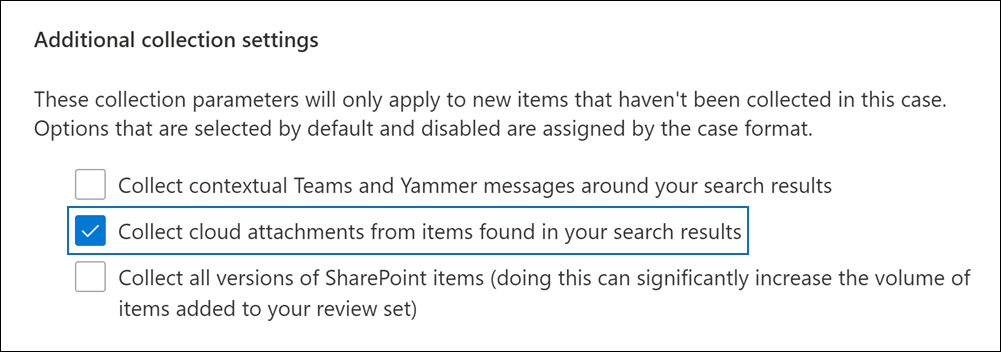
Within the Microsoft M365 email environment, searching and collecting email, including its embedded and cloud attachments, is facilitated by a suite of features called Microsoft Purview. Terming any task in eDiscovery “one-click easy” risks oversimplification, but the Purview eDiscovery (Premium “E5”) features are designed to make collection of cloud attachments to M365 email nearly as simple as ticking a box during collection.
When a party using Microsoft M365 email elects to collect (export) a custodian’s email for search, they must decide whether to collect files sent as cloud attachments so they may be searched as part of the message “family,” the term commonly applied to a transmitting message and its attachments. Preserving this family relationship is important because the message tells you who received the attachments and when, where searching the attachments tells you what information was shared. The following screenshot from Microsoft illustrates the box checked to collect cloud attachments. Looks “one-click easy,” right?
By themselves, the cloud attachment links in a message reveal nothing about the content of the cloud attachments. Sensibly, the target documents must be collected to be assessed and as noted, the reason they are linked is not because they have some different character in terms of their relevance; many times they are linked because they are larger files, so to that extent, they hold a greater volume of potentially relevant information.
Just as it would not have been reasonable in the days of paper discovery to confine a search to documents on your desk but not in your desk, it’s not reasonable to confine a search of email attachments to embedded attachments but not cloud attachments. Both are readily accessible to the custodians of the email using the purpose-built tools Microsoft supplies to its email customers.
Microsoft Purview collects cloud attachments as they exist at the time of collection; so, if the attachment was edited after transmittal, the attachment will reflect those edits. The possibility that a document has been edited is not a new one in discovery; it goes to the document’s admissibility not its discoverability. The relevance of a document for discovery depends on its content and logical unitization, and assessing content demands that it be searched, not ignored on the speculative possibility that it might have changed.
If a cloud attachment were changed after transmittal, those changes are customarily tracked within the document. Accordingly, if a cloud attachment has run the gauntlet of search and review, any lingering suspicion that the document was changed may be resolved by, e.g., production of the version closest in time to transmittal or by the parties meeting and conferring. Again, the possibility that a document has been edited is nothing new; and is merely a possibility. It’s ridiculous to posit that a party may eschew collecting or producing all cloud attachments because some might have been edited.
Cloud attachments are squarely within the ambit of what must be assessed for relevance. The potential for a cloud attachment to be responsive is no less than that of an item transmitted as an embedded attachment. The burden claimed by responding parties grows out of their failure to do what clearly should have been done in the first place; that is, it stems from the responding party’s decision to exclude potentially relevant, accessible documents from being collected and searched.
If you’re smart, Dear Reader, you won’t fail to address cloud attachments explicitly in your proposed ESI Protocols and/or Requests for Production. I can’t make this point too strongly, because you’re not likely to discover that the other side didn’t collect and search cloud attachments until AFTER they make a production, putting you in the unenviable posture of asking for families produced without cloud attachments to be reproduced with cloud attachments. Anytime a Court hears that you are asking for something to be produced a second time in discovery, there’s a risk the Court may be misled by an objection grounded on Federal Rule of Civil Procedure Rule 34(b)(2)(E)(iii), which states that, [a] party need not produce the same electronically stored information in more than one form.” In my mind, “incomplete” and “complete” aren’t what the drafters of the Rule meant by “more than one form,” but be prepared to rebut the claim.
At all events, a party who failed to collect cloud attachments will bewail the need to do it right and may cite as burdensome the challenge of distinguishing items reviewed without cloud transmittals from those requiring review when made whole by the inclusion of cloud attachments.
Once a party collects cloud attachments and transmittals, there are various ways to distinguish between messages updated with cloud attachments and those previously reviewed without cloud attachments. Identifying families previously collected that have grown in size is one approach. Then, by applying a filter, only the attachments of these families would be subjected to supplementary keyword search and review. The emails with cloud attachments that are determined to be responsive and non-privileged would be re-produced as families comprising the transmittal and all attachments (cloud AND embedded). An overlay file may be used to replace items previously produced as incomplete families with complete families. No doubt there are other efficient approaches.
If all transmittal messages were searched and assessed previously (albeit without their cloud attachments), there would not be a need to re-assess those transmittals unless they have become responsive by virtue of a responsive cloud attachment. These “new” families need no de-duplication against prior production because they were not produced previously. I know that sounds peculiar, but I promise it makes sense once you think through the various permutations.
With respect to using hash deduplication, the hash value of a transmittal does not change because you collect a NON-embedded cloud attachment; leastwise not unless you change the way you compute the hash value to incorporate the collected cloud attachment. Hash deduplication of email has always entailed the hashing of selected components of messages because email headers vary. Accordingly, a producing party need compare only the family segments that matter, not the ones that do not. In other words, de-duplicating what has been produced versus new material is a straightforward process for emails (and one that greatly benefits from use of the EDRM MIH). Producing parties do not need to undertake a wholesale re-review of messages; instead, they need to review for the first time those things they should have reviewed from inception.
I’ll close with a question for those who conflate cloud attachments (which reside in private cloud respositories) with hyperlinks to public-facing web resources, objecting that dealing with collecting cloud attachments will require collection of all hyperlinked content. What have you been doing with the hyperlinks in your messages until now? In my experience, loads of us include a variety of hyperlinks in email signature blocks. We’ve done it for years. In my email signature, I hyperlink to my email address, my website and my blog; yet, I’ve never had trouble distinguishing those links from embedded and cloud attachments. The need to integrate cloud attachments in eDiscovery is not a need to chase every hyperlink in an email. Doug Austin does a superb job debunking the “what about hyperlinks” strawman in Assumption One of his thoughtful post, “Five Assumptions About the Issue of Hyperlinked Files as Modern Attachments.”
Bottom Line: If you’re an M365 email user; you need to grab the cloud attachments in your Microsoft repositories. If you’re a GMail user, you need to grab the cloud attachments in your Google Drive respositories. That a custodian might conceivably link to another repository is no reason to fail to collect from M365 and GMail.