• Home
  • About
  • CRAIGBALL.COM
  • Disclaimer
  • Log In

Ball in your Court

~ Musings on e-discovery & forensics.

Ball in your Court

Category Archives: Uncategorized

Cross-Matter & -Vendor Message ID

04 Sunday Sep 2016

Posted by craigball in Computer Forensics, E-Discovery, Uncategorized

≈ 11 Comments

At last week’s ILTACON in Washington, D.C., Beth Patterson, Chief Legal & Technology Services Officer for Allens in Sydney asked a panel why e-discovery service providers couldn’t standardize hash values so as to support identification and deduplication across products and collections.  If they did, you could use work from one matter in another.  If an e-mail is privileged in one case, there’s a good chance it’s privileged in another; so, wouldn’t it be splendid to be able to flag its counterparts to insure it doesn’t slip through without review?

Beth asked a great question, and one regrettably characterized by the panel as “a big technical challenge.”

One panelist got off on the right foot:  He said, “I’ve created artificial hashes in the past where what I had to do was aggregate and normalize metadata across different data sets to create a custom fingerprint to do that.”  But, he added, “that’s probably not defensible, and it’s also really cumbersome.”

Pressed by Beth, the panel pushed back.  “It’s because artificial hashes are kind of complicated,” one panelist offered, and not “a trivial technical problem.”  The panel questioned whether MD5 hashes were the appropriate standard or whether SHA-1 would be required, positing that cross-matter deduplication is “something that requires significant buy-in across a broad spectrum of people.”  Beth’s request was ultimately dismissed as “not an easy challenge” and one that would be confounded by “people, process and technology” and “the MD5 hash stuff.”

ILTACON is the rare venue where reasonably well-adjusted and -socialized people engage in lively discussions of such things.  It’s not just that ILTA folks understand the technology issues (“GEEKS!”), we’re passionate about them (“NERDS!”) and debate them respectfully as peers (“WUSSIES!”).

Beth’s idea deserved more credit than it got.  It really is a trivial technical problem, and one that could be resolved without much programming or politics. Continue reading →

Share this:

  • Email a link to a friend (Opens in new window) Email
  • Print (Opens in new window) Print
  • Share on X (Opens in new window) X
  • Share on Facebook (Opens in new window) Facebook
  • Share on LinkedIn (Opens in new window) LinkedIn
Like Loading...

A Glimpse of China: Prosperity and Purpose

30 Saturday Jul 2016

Posted by craigball in Personal, Uncategorized

≈ 12 Comments

This essay isn’t about electronic evidence; so, if that’s what you came for, sorry.  I just had to spout off somewhere about China.

Most who know me know my lifelong passion for travel.  An astonished, “you’ve been everywhere,” often ends conversations that start, “where have you traveled?”  But, there are places I’ve missed around the globe, and until now, one of those was mainland China.  I’d been to Hong Kong; but, not all think that going to Hong Kong is the same as going to Big Red.

I expected China would be crowded, dirty and grim, like Roman Polanski’s Chinatown, but bigger.  I grew up with images of Communist China: Chairman Mao and missiles on parade: platoons of children marching in khaki with boxy green caps and red stars.  I imagined meals of chicken feet and fish eyes, lots of pagodas and poverty, and street’s teeming with bicycles.  Boy, did I miss the sampan on modern China!

I’ve been on the move in China for a couple of weeks, and am challenged to find suitable superlatives to describe this miracle of progress and prosperity.  I have t-shirts that are older than the thousands of soaring skyscrapers scaling the magnificent city skylines of Shanghai, Xi’an and Chongqing.  Shanghai alone has over 2,000 buildings above forty stories that were built since 2000.

And what fantastic buildings! Continue reading →

Share this:

  • Email a link to a friend (Opens in new window) Email
  • Print (Opens in new window) Print
  • Share on X (Opens in new window) X
  • Share on Facebook (Opens in new window) Facebook
  • Share on LinkedIn (Opens in new window) LinkedIn
Like Loading...

EDna: Still Cheap and Challenged

15 Friday Apr 2016

Posted by craigball in Computer Forensics, E-Discovery, Uncategorized

≈ 39 Comments

EDna2016

About seven years ago, I e-mailed a hypothetical to colleagues seeking their advice about how to process and review an unprepossessing volume of ESI for production in e-discovery.  The intelligence they shared became fodder for The EDna Challenge and, I like to think, helped promote lower cost e-discovery options in the marketplace.

Since then, three of the contributors (Browning Marean, Ross Kodner and Dave Kleiman) have passed on and nearly all have moved on.  But, the challenge remains challenging.  The good news is that Edna now has five times more money to spend.

Next week’s ACEDS Conference seeks a re-examination of EDna options circa 2016 on a bigger budget; so, may I please impose on you, Dear Reader, to share your suggestions drawing on the much broader array of options available today?  Please add your suggestions as comments, and it’s fine to toot your own horn so long as you don’t exceed the budget, all in, and meet all the requirements of the challenge.

Here’s the updated challenge:

Your old friend, Edna, called with a question.  She has a small law firm.  A client is about to send her a Zip file on a thumb drive containing collected ESI in a construction dispute.  It will be PSTs for six people, another four MBOX takeouts from Gmail and a mixed bag of word processed documents, spreadsheets, PowerPoint documents, PDFs and “not a lot” of scanned paper documents (sans OCR or load files) for all ten custodians.  There may also be some video, photographs and web content.  “Nothing too hinky,” she promises.  She thinks it will comprise less than 50,000 documents in all, but it could grow to 100,000 items or more.  The contents will unzip to about 10-12 GB in all.

She’s determined to conduct a paperless privilege and responsiveness review of the material in-house, sharing the task with an associate and legal assistant.  Everyone has a high-end, big screen desktop PC running Windows 8.1 with MS Office 2016 and Adobe Acrobat 11 Pro installed.  The office’s network file server has loads of available storage space.  She doesn’t own a review tool.  She’s willing to spend up to $5,000.00 ALL IN, for software, vendor services, SaaS, whatever, exclusive of the cost of her time and staff time), but she won’t spend a penny more.  You can’t loan her your systems or software.  You can’t talk her out of it.  Pricing must mirror real-world availability, not a special deal.

Edna’s solution must support:

  • Efficient workflow
  • Robust search
  • Ability to process relevant metadata
  • Simple document tagging and production identification
  • Effective tracked deduplication
  • Review may take up to 90 days, and the case may not conclude for up to two years.  All review,  hosting and production costs must be borne by the budget.

How should Edna spend that $5,000.00?

Share this:

  • Email a link to a friend (Opens in new window) Email
  • Print (Opens in new window) Print
  • Share on X (Opens in new window) X
  • Share on Facebook (Opens in new window) Facebook
  • Share on LinkedIn (Opens in new window) LinkedIn
Like Loading...

Luddite Lawyer’s Guide to Computer Backup Systems

05 Tuesday Apr 2016

Posted by craigball in Computer Forensics, E-Discovery, Uncategorized

≈ 8 Comments

It will come as no surprise to readers that I cleave to simple credos when it comes to litigation and e-discovery, viz.

  • Most evidence today is digital.  It’s powerful, persuasive and pervasive.
  • Being a lawyer is a privilege; our competence is the least clients deserve.
  • Trial lawyers should be competent in matters of evidence and discovery.
  • Competence in evidence entails competence in e-evidence.
  • Competence in discovery entails competence in e-discovery.
  • You’re not competent in e-evidence or e-discovery if you ignore the “e.”
  • Knowing the law is one thing. Attorneys are smart and can learn a second thing.
  • Attorneys trade in information;  that “second thing” should be information technology.

These are inarguable assertions in my mind; but, somehow, they remain controversial in practice.  The controversy endures because of the equally inarguable fact that those who set the standards for lawyer competence will never draw the circle of competence in such a way that they are left standing outside of the circle.  If it were important to know, they reason, they would already know it.  Discouraging.

But things will change, and when they do–when lawyers wake to the power of ESI–they will want materials that teach the “e,” not just the discovery.  They will want materials written by lawyers, for lawyers.

I’ve been laboring to contribute some of those materials for many years;  so long, in fact, that I’m chagrinned by how dated some of my early writings feel.  Back in 2009, I wrote a long essay–a primer really– for the Georgetown E-Discovery Institute, back when there was still a plenary technical topic covered during that storied event.  It was a primer on backup systems, which were still pretty central to high-profile e-discovery disputes back then.  Over the years, I’ve written lawyer-friendly technical primers on computer forensics, e-mail systems and databases to accompany other Tech Focus sessions at Georgetown, before the heresy of teaching information technology to lawyers at the Institute was recognized as being less promising than, say, teaching a pig to mambo. These primers, too, were getting long in the tooth and just felt, well, tired.

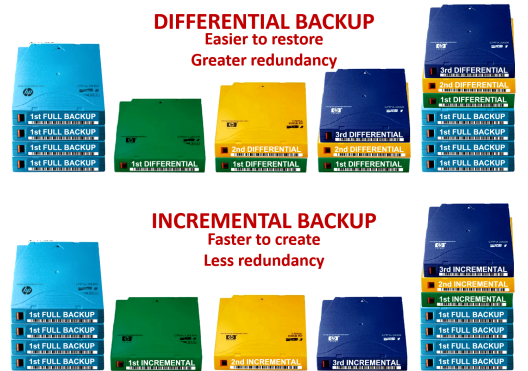
So, today, I spent the whole day extensively rewriting and updating the primer on backups. It’s now called the Luddite Lawyer’s Guide to Backup Systems, and I’m happy to put it back out there, fresh for 2016.  In addition to updating it to reflect the state-of-art in backup techniques and media, I added some nifty new stuff and graphics, like this colorful illustration to accompany my explanation of the difference between differential and incremental backups:

backup-differential vs incremental

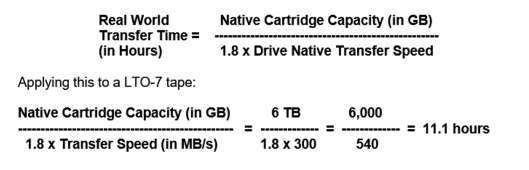
I also came up with a formula to calculate the real world transfer time for backup tapes and compiled and included a list of the values needed to plug into the formula for just about every format of backup tape used for the last thirty years:

real world tape times

I wrapped up the rewrite by adding ten practice tips for dealing with backups in civil discovery.

If you’re interested in digging into what makes backups go, and how to address them in civil discovery, I hope you give the latest Luddite Lawyer’s Guide a peek.  You don’t have to be a Luddite; but if you are and read the primer, there’s good chance you won’t be able to call yourself a Luddite anymore.  Feedback welcome.  Criticism encouraged.  Thanks.

Share this:

  • Email a link to a friend (Opens in new window) Email
  • Print (Opens in new window) Print
  • Share on X (Opens in new window) X
  • Share on Facebook (Opens in new window) Facebook
  • Share on LinkedIn (Opens in new window) LinkedIn
Like Loading...

“EDD Competency” Rhymes with “EDD Utterly Free”

11 Friday Mar 2016

Posted by craigball in E-Discovery, General Technology Posts, Uncategorized

≈ 6 Comments

gainesvilleI haven’t posted in ages per the Mr. Ed Rule.  For those too young to remember the talking horse of early-60s TV, the theme song says, “Mr. Ed will never speak unless he’s got something to say.”  Sorry, Wilbur.  I just didn’t have anything to say, and didn’t wish to waste your time.  But, now I’ve got something worth writing about, and a gift to share.
Last year at this time, I wrote about Bill Hamilton and the excellent, intimate e-discovery conferences he convenes in central Florida at the University of Florida, Levin College of Law.  The UF campus is in Gainesville, and to be honest, it’s not an easy place to reach unless you’re an alligator or live in Charlotte, Atlanta or Miami.  I fly to Orlando and drive two hours.  So, you’ve really got to want to go to Gainesville.  And, thanks to Bill and his distinguished UF Law E-Discovery Project, I often do want to go there.  So should you. Here’s why:

Bill has generously allowed me to make you, dear reader, my guest at the fourth annual EDRM E-Discovery Conference on March 30.  Free, on campus or via the webcast, from anywhere.  Free is my favorite price.  How about you?

Free wouldn’t mean much if what you got wasn’t valuable.  This conference is always a good one.  Check out the agenda.  Bill has countless friends in the e-discovery space and when he calls, many make the trek to Gainesville to support this fine event.  It’s going to be good.

Now, let me sweeten the pot.  There’s an included breakfast, lunch and reception.  Need more?  This morning, it costs $97.00 to fly to Gainesville from LGA or JFK (via Miami) on American Airlines.  From Washington, D.C., how about 83 bucks nonstop on United?   It’s balmy in Gainesville, folks, mid-80s!  To get there from the forty degrees colder Boston, a flight is just $97.00.  At those prices, the free admission pays the airfare, and you get to hang with and learn from a great bunch of people.  Did someone say, ROAD TRIP!?!?!

To get free admission, go to the Conference registration page and locate the link for “Enter promotional code,” in the lower right.  Enter the code CBall16 and marvel as all the registration options change to “Free.”  Don’t hesitate.  Use it now.  Hope to see you there.  We can thank Bill together as we enjoy our free lunches.

Share this:

  • Email a link to a friend (Opens in new window) Email
  • Print (Opens in new window) Print
  • Share on X (Opens in new window) X
  • Share on Facebook (Opens in new window) Facebook
  • Share on LinkedIn (Opens in new window) LinkedIn
Like Loading...

Does Evidence Derive from Discovery?

16 Thursday Oct 2014

Posted by craigball in E-Discovery, Uncategorized

≈ 14 Comments

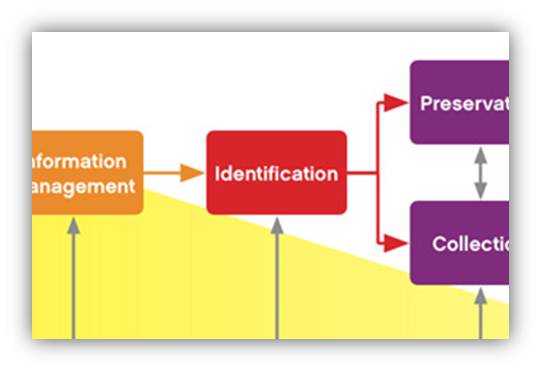
edrm-IDIs anyone else troubled that the most oft-cited research into e-discovery–the Blair & Marron study of keyword search–dates from 1985? Recent “studies” are often seat-of-the-pants opinion polls of the sort that ask in house counsel to guess how well prepared their companies are to deal with e-discovery or what they think discovery costs. These are interesting; but, they’re no more reliable than polls asking people to rate themselves as “fair minded” or “intelligent.” Polls measure people’s expectations about what facts might be, not facts. The long-held consensus that the sun circled a flat Earth didn’t make it so.

We need objective metrics in e-discovery, and one thing I’d like to see measured is the origin of the information obtained in discovery that’s actually used to prosecute or defend cases. My experience is that cases are won or lost using a handful of items versus the number exchanged in discovery. Do the exhibits used in motions, depositions and trials derive from e-discovery or do they emerge by other means? Continue reading →

Share this:

  • Email a link to a friend (Opens in new window) Email
  • Print (Opens in new window) Print
  • Share on X (Opens in new window) X
  • Share on Facebook (Opens in new window) Facebook
  • Share on LinkedIn (Opens in new window) LinkedIn
Like Loading...

Browning Marean 1942 – 2014

23 Saturday Aug 2014

Posted by craigball in E-Discovery, Personal, Uncategorized

≈ 66 Comments

browning_mareanBrowning Endicott Marean III, 71, passed away last night in a hospital in his adopted hometown of San Diego. He died of complications attendant to a six month course of aggressive treatment for esophageal cancer.  Browning was not ready to go, and he fought his fate with the grace, intelligence, steadiness and humor that made us love him.  Browning Marean was the world’s best known and most admired ambassador for e-discovery, the peripatetic mayor of our global village.  No one traveled further, spoke more or put a better face on the American approach to the exchange of information in litigation than Browning.  Lawyers around the world think Americans mad when it comes to civil discovery; but when they heard Browning speak, when they heard that mellifluous radio announcer voice, they thought better of us.  And that was Browning in a nutshell: a wise, avuncular presence who just made you feel that everything would be all right. He touched my life for good, and I will miss him with all my heart.  In that, I am far from alone. Continue reading →

Share this:

  • Email a link to a friend (Opens in new window) Email
  • Print (Opens in new window) Print
  • Share on X (Opens in new window) X
  • Share on Facebook (Opens in new window) Facebook
  • Share on LinkedIn (Opens in new window) LinkedIn
Like Loading...

A Guide to Forms of Production

19 Monday May 2014

Posted by craigball in Computer Forensics, E-Discovery, Uncategorized

≈ 6 Comments

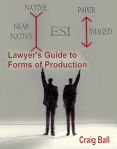
forms_iconSemiannually, I compile a primer on some key aspect of electronic discovery.  In the past, I’ve written on computer forensics, backup systems, metadata and databases. For 2014, I’ve completed the first draft of the Lawyers’ Guide to Forms of Production, intended to serve as a primer on making sensible and cost-effective specifications for production of electronically stored information.  It’s the culmination and re-purposing of much that I’ve written on forms heretofore, along with new material extolling the advantages of native and near-native forms.

Reviewing the latest draft, there is much I want to add and re-organize; accordingly, it will be a work-in-progress for months to come.  Consider it a “public comment” version.  The linked document includes exemplar verbiage for requests and model protocols for your adaption and adoption.  I plan to add more forms and examples. Continue reading →

Share this:

  • Email a link to a friend (Opens in new window) Email
  • Print (Opens in new window) Print
  • Share on X (Opens in new window) X
  • Share on Facebook (Opens in new window) Facebook
  • Share on LinkedIn (Opens in new window) LinkedIn
Like Loading...

Thanks. Can You Do Me a Favor Please?

19 Sunday Jan 2014

Posted by craigball in Computer Forensics, E-Discovery, General Technology Posts, Personal, Uncategorized

≈ 5 Comments

Sorry to take your time asking for help. so I’ll be quick about it.

But first, thank you.  Thanks to you, dear reader, this blog and its 85 posts reached 100,000 views a few days ago.  That’s nothing compared to the millions of page views others see, but it’s very gratifying to me because I launched this blog without saying a word to anyone.  Somehow, you just found it.  Ball in Your Court is an outlet born of frustration with the two-month publication lag attendant to my former print column and the sudden shuttering of an American Lawyer Media blog where I’d previously posted.  I wanted a place where no one could pull the plug but you or me.  This blog is a very personal connection to you.

The favor I ask is this:  if you like the content here or find it of some value, please share it with someone you think might be interested.  If you have a blog or site with a blogroll, please consider adding Ball in Your Court to your blogroll.  I will try to earn my place on your page and in your day.  Thanks.

Share this:

  • Email a link to a friend (Opens in new window) Email
  • Print (Opens in new window) Print
  • Share on X (Opens in new window) X
  • Share on Facebook (Opens in new window) Facebook
  • Share on LinkedIn (Opens in new window) LinkedIn
Like Loading...

Transparency of Process No Peril to Work Product

16 Monday Dec 2013

Posted by craigball in Computer Forensics, E-Discovery, Uncategorized

≈ 13 Comments

I’m rarely moved to criticize the work of other commentators because, even when I don’t share their views, I applaud the airing of the issues their efforts bring.  But sometimes a proposition is just so blatantly ill-advised, so prone to unfairly tilt the litigation playing field, that any reader and every writer should stop and say, “Wait a second….”  One such article, currently running in the New York Law Journal and called No Disclosure: Why Search Terms Are Worthy of Court’s Protection, charges that judges who require disclosure of search terms “discount or misunderstand” what the authors term the “protected nature of key aspects of the e-discovery process,” namely filtering of data by use of search terms.  The authors think that disclosure of search terms used to exclude data from disclosure compromises the work product privilege and argue that judges should “recognize that a search term is more than a collection of words, rather, the culmination of an attorney’s interaction with the facts of the case.”

Espousing the sanctity of work product privilege to an audience of litigators is like saying, “I support our troops.”  It’s mom, baseball and apple pie.  It’s also popular to paint judges as addled abusers of discretion.  But let’s not let jingoism displace judgment.  Search terms are precisely what the authors claim they are not: search terms are a collection of words.  They are lexical filters.  Nothing more.

Search terms deserve no more protection from disclosure than date ranges, file types and other mechanical means employed to exclude data from scrutiny.  Search terms strip out information that will never see the light of day nor benefit from the application of lawyer judgment as to their relevance.  In that sense, search terms are anathema to the core principles of work product and warrant more, not less, scrutiny. Continue reading →

Share this:

  • Email a link to a friend (Opens in new window) Email
  • Print (Opens in new window) Print
  • Share on X (Opens in new window) X
  • Share on Facebook (Opens in new window) Facebook
  • Share on LinkedIn (Opens in new window) LinkedIn
Like Loading...
← Older posts
Newer posts →
Follow Ball in your Court on WordPress.com

Enter your email address to subscribe to this blog and receive notifications of new posts by email.

Join 2,240 other subscribers

Recent Posts

  • A Little Grace November 3, 2026
  • Stolen Valor, Esquire October 31, 2026
  • Fifteen Years in Your Court August 21, 2026
  • The AI Protective Order Double Standard July 27, 2026
  • Drafting RFPs for Robots to Read July 20, 2026

Archives

RSS Feed RSS - Posts

CRAIGBALL.COM

Categories

EDD Blogroll

  • Basics of E-Discovery (Exterro)
  • Minerva 26 (Kelly Twigger)
  • Illuminating eDiscovery (Lighthouse)
  • E-Discovery Law Alert (Gibbons)
  • Complex Discovery (Rob Robinson)
  • The Relativity Blog
  • CS DISCO Blog
  • Sedona Conference
  • E-D Team (Ralph Losey)
  • Corporate E-Discovery Blog (Zapproved )
  • eDiscovery Journal (Greg Buckles)
  • eDiscovery Today (Doug Austin)
  • GLTC (Tom O'Connor)

Admin

  • Create account
  • Log in
  • Entries feed
  • Comments feed
  • WordPress.com

Enter your email address to follow Ball in Your Court and receive notifications of new posts by email.

Website Powered by WordPress.com.

  • Subscribe Subscribed
    Ball in your Court
    Join 2,092 other subscribers

    Have a WordPress.com account? Log in now.

  • Ball in your Court
    View site in Reader
    Manage subscriptionsSign upLog in
    Report this content
    Collapse this bar
Loading Comments...
%d