Imagining the Evidence

Whether you call it “predictive coding” or “technology assisted search,” the time is nigh when we will leave much of the heavy lifting of search to machines trained to find responsive documents. These tools won’t be the heuristic marvels like HAL-9000 envisioned by Arthur C. Clarke, but they probably won’t try to kill us either.

We’ll train these tools by presenting them with examples of patently responsive documents culled by flesh-and-blood reviewers from key custodians’ ESI. Using sophisticated algorithms that analyze these “seed sets” and identify patterns, the tools will ferret out other documents like the examples. Because we can train the tools to find similar ESI using any documents, we won’t be relegated to using seed sets derived from actual documents. We can train the tools with contrived documents–fabrications of items like the genuine counterparts we hope to find. I call this “imagining the evidence,” and it’s not nearly as crazy as it sounds.

Continue reading

Should a Legal Hold “Waiver” Be Secured from Departing Employees?

While my wife trims the tree this lazy Saturday, I’m enjoying splendid articles by Mark Sidoti, chair of the Gibbons E-Discovery Task Force.  That job title gave me brief pause.  Oh, no! Have e-discovery costs driven corporations to outsource review to a shrewdness of arboreal apes?  As it turns out, Gibbons is a 230-lawyer firm in and around New Jersey (and, yes, a group of apes is really called a “shrewdness of apes.”  Don’t you just love the idiosyncracies of the English language?).

Sidoti’s EDD articles can be found on his bio pageOne of these discusses the decision in NVE, Inc. v. Palmeroni, where Judge Esther Salas (USDC DNJ) sanctioned the plaintiff for failing to take reasonable steps to preserve relevant ESI pertaining to  alleged breach of fiduciary duty by its former employee, Palmeroni.  The Court determined that the plaintiff’s obligation to preserve arose when it terminated Mr. Palmeroni’s employment–a time when, the court notes, “litigation was imminent.” Continue reading

Agatha, Hercule, Mummy and Me

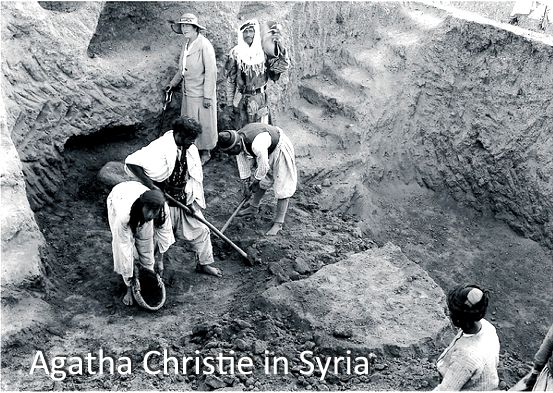
Three weeks ago, skulking around the mummies in a small-but-fine museum on the University of Sydney campus, I learnt that mystery writer Agatha Christie was married to archaeologist, Max Mallowan, and that she’d assisted him in Syrian digs.  Dame Agatha even used her cold cream and knitting needles to clean rare ivory artifacts.  The experience found its way into her work.  An exhibit of Christie-cleaned carvings included a quote from the author’s fictional detective, Hercule Poirot, in Death on the Nile (1937):

Once I went professionally to an archaeological expedition–and I learnt something there.  In the course of an excavation, when something comes up out of the ground, everything is cleared away very carefully all around it.  You take away the loose earth, and you scrape here and there with a knife until finally your object is there, all alone, ready to be drawn and photographed with no extraneous matter confusing it. That is what I have been seeking to do–clear away the extraneous matter so that we can see the truth–the naked shining truth.

This naturally got me thinking about the way we approach search in electronic discovery.  Continue reading

A Good Decision Brings Out the Bullies

I don’t know U.S. Magistrate Judge James L. Cott of the Southern District of New York.  I couldn’t even find a photo of him save the one at left singing with the Harvard Krokodiloes circa 1978.  But Judge Cott has my admiration and sympathy for a good decision that’s under attack by well-funded business interests who’ve picked the wrong case to rally their troops.

The truth is, in Pippins v. KPMG, it was KPMG’s poor presentation of the issues and evidence (ironic, as they’re one of the biggest e-discovery vendors in the trade) that left Judge Cott no option but to rule as he did–and surely the smart folks hired to condemn the decision know that.  But that’s not stopping the rush to pillory the magistrate.  One big firm commentator even called the result “stupid.” That’s just mean.

What really ticks off the big firm bar and Chamber of Commerce lobby is the fact the  judge didn’t simply rule and slink away.  No, His Honor had the temerity to explain why he couldn’t just incant “proportionality” and miraculously gloss over the glaring absence of factual and legal justification to support KPMG’s request to discard evidence. Continue reading

When Books are Trash

Before I have my say, know that I love books–the kind with bindings and jackets and heft and creamy paper. Books on paper hold as cherished a place in my heart as yours.

But books on paper are not long for this world. Some will survive, much as vinyl records have endured the advent of tape, CDs and digital audio. But like vinyl records, books on paper will become a niche product for purists and oddballs. The rest will be collectors’ items and garage sale curios until, finally, books on paper are trash. Sad, but inevitable.

We have a transition problem. I want to own my books in digital formats, but I don’t want to have to buy them again when I’ve already paid for the content on paper. And, I want to be able to give or loan parts of my library to others. After all, the greatest joy of owning a book I’ve benefitted from reading is to pass it on to a new reader. Continue reading

Down Under

Dear Reader,

I’ve been in Australia for a couple of weeks, at an e-discovery conference in Sydney and traveling to see this beautiful and engaging country. Please forgive the paucity of posts while I’m enjoying the land down under.

Sydney may be the most beautiful city I’ve ever seen, and save for a few in South America and South Africa, I’ve seen most of them. Having fabulous weather and generous hosts helped, but all the Sydneysiders we met were friendly and helpful. Nuix mounted a heck of a great users’ conference that encouraged a lot of advanced thinking about the direction of EDD. There aren’t enough superlatives to do the event justice. Peter Mercer of Vound Software kindly shared a day showing my wife and me the glorious northern beaches most tourists never see. So many kindnesses shared by friends and strangers.

The Blue Mountains (two hours west of Sydney) and the Great Ocean Road (southwest of Melbourne) are extraordinarily beautiful, rivaling any vistas, anywhere. Yes it’s expensive to visit Australia right now, and it’s a long flight, but it’s well worth every penny and every hour. My only regret is that I didn’t get here sooner!

Do We Need a Porn Pass?

Ah, porn.  The fabric free entertainment that folks just won’t leave at home.  In his concurring opinion in Jacobellis v. Ohio 378 U.S. 184 (1964), Justice Potter Stewart famously said of hardcore pornography, “I know it when I see it.”  If Justice Stewart had practiced in the era of e-discovery, he’d know it well indeed.

Forensic examiners joke that porn is a perk of the job because we come across it so often on workplace systems, mainly in e-mail.  Most is softcore stuff or cheesecake shared more for humor than titillation; but some can be pretty raw.  It can be tortious, as well…and when subjects skew too young, a felony.

Workplace porn is a problem, perhaps nowhere more so than when it’s inadvertently produced to the other side in e-discovery.  You may wonder, “Does that really happen?”  Let me assure you it occurs with astonishing regularity; and I expect it to happen more as we trade human review for mechanized categorization techniques like predictive coding.  Say what you will about bored contract reviewers, pictures of naked folks afrolic tend to catch their eye.  Not so machines…unless tasked to look for skin tones, and even then baby pictures pass for ‘oh baby’ pictures.

As I sit here shaking my head at a production set where porn crossed over, I ask you dear reader: Do we need a porn pass?

Continue reading

A Changing Definition of Deletion

They’re talking about changing the federal e-discovery rules to lessen the fear and loathing attendant to preservation of ESI.

The unstated impetus is that federal judges can’t be trusted to weigh preservation and mete out sanctions in ways fairly attuned to facts and culpability. The proposed amendments seek to wrest the gavels from cranky judges whose 20/20 hindsight and outsize expectations operate to impose an impossible, perilous standard nationwide.  Or so goes the rhetoric.

It’s a crock.  We give federal judges a job for life, but can’t trust them to do that job wisely and well?!?  Did we not learn anything from the debacle of mandatory sentencing guidelines?

The proposed changes are driven by the second silent goal of sparing litigants (really their technologically challenged counsel) the chore of knowing enough about electronic evidence and information technology to make defensible decisions about preservation.  “Don’t make us learn anything,” they plead, “just make rules specific enough to protect us from not knowing.” The rub with grafting such specificity onto e-discovery is that information technology moves far more swiftly than rule making, such that amendments like those proposed principally benefit those who can’t or won’t keep up. Continue reading

The Shadow Knows

“You can get anything back from a computer, can’t you?  Even the deleted stuff!”

I get that that a lot, and tend to respond, “Pretty much.”  My lawyer side wants to add, “but it depends.”  Like most in computer forensics, I tend to downplay the challenges and uncertainties of data recovery, not so much to promote forensic examination as to discourage data destruction.  Until a forensic examiner processes the evidence, it’s hard to say whether we can recover particular deleted data; but dollars-to-diamonds, a forensic exam will shed light on the parties and issues.

Lately, the likelihood of recovering deleted files on late-model Windows systems has gone way, way up, even if the data’s been thoroughly flushed from the Recycle Bin.  Microsoft has been gradually integrating a feature called Volume Snapshot Service (a/k/a Volume Shadow Copy Service) into Windows since version XP; but until the advent of Windows 7, you couldn’t truly say the implementation was so refined and entrenched as to permit the recovery of anything a user deletes from a remarkable cache of data called Volume Shadow Copies.

Volume shadow copies are old news to my digital forensics colleagues, but I suspect they are largely unknown to the e-discovery community.  Though a boon to forensics, volume shadow copies may prove a headache in e-discovery because their contents represent reasonably accessible ESI; that is, much more potentially probative evidence that you can’t simply ignore. So, for heaven’s sake, don’t tell anybody. 😉 Continue reading

A Bit About Data Mapping

Earlier this week, I did a webcast on “data mapping.” Data mapping is one of those nimble e-discovery buzz words–like ECA and Predictive Coding–that takes on any meaning the fertile minds in the Marketing Department care to ascribe.

I use “data mapping” to encompass methods used to memorialize the identification of ESI–an essential prerequisite to everything in the EDRM east of Information Management. Of course, like Nessie and Bigfoot, Information Management is something many believe exists but no one has ever shown to be anything but a myth. Consequently, identification of ESI, viz. data mapping, is the de facto entry point for all things e-discovery.

Continue reading