
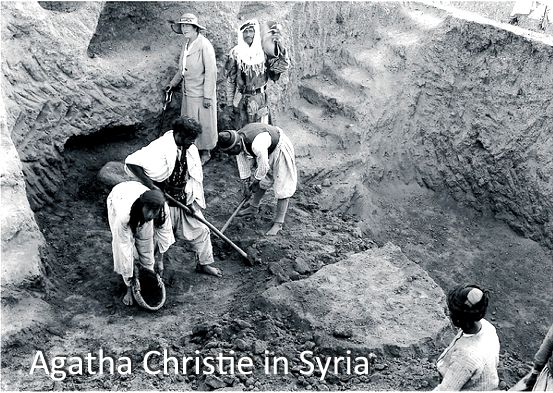
 Three weeks ago, skulking around the mummies in a small-but-fine museum on the University of Sydney campus, I learnt that mystery writer Agatha Christie was married to archaeologist, Max Mallowan, and that she’d assisted him in Syrian digs. Dame Agatha even used her cold cream and knitting needles to clean rare ivory artifacts. The experience found its way into her work. An exhibit of Christie-cleaned carvings included a quote from the author’s fictional detective, Hercule Poirot, in Death on the Nile (1937):
Once I went professionally to an archaeological expedition–and I learnt something there. In the course of an excavation, when something comes up out of the ground, everything is cleared away very carefully all around it. You take away the loose earth, and you scrape here and there with a knife until finally your object is there, all alone, ready to be drawn and photographed with no extraneous matter confusing it. That is what I have been seeking to do–clear away the extraneous matter so that we can see the truth–the naked shining truth.
This naturally got me thinking about the way we approach search in electronic discovery. Continue reading






 Ball in your Court