Location. Location. Location.

Gladys_KravitzI’m peripatetic.  My stuff lives in Austin; but, I’m in a different city every few days.  Lately looking for a new place for my stuff to await my return, I’m reminded of the first three rules of real estate investing: 1. Location; 2. Location and 3. Location.

Location has long been crucial in trial, too: “So, you claim you were at home alone on the night of November 25, 2014 when this heinous crime was committed!  Is that what you expect this jury to believe?”  If you can pinpoint people’s locations at particular times, you can solve crimes.  If you have precise geolocation data, you can calculate speed, turn up trysts, prove impairment, demonstrate collusion and even show who had the green light. Location and time are powerful tools to implicate and exonerate.

A judge called today to inquire about ways in which cell phones track and store geolocation data.  He wanted to know what information is recoverable from a seized phone.  I answered that, depending upon the model and its usage, a great deal of geolocation data may emerge, most of it not tied to making phone calls.  Tons of geolocation data persist both within and without phones.

Cell phones have always been trackable by virtue of their essential communication with cell tower sites.  Moreover, and by law, any phone sold in the U.S. must be capable of precise GPS-style geolocation in order to support 9-1-1 emergency response services. Your phone broadcasts its location all the time with a precision better than ten meters. Phones are also pinging for Internet service by polling nearby routers for open IP connections and identifying themselves and the routers.  You can forget about turning off all this profligate pinging and polling.  Anytime your phone is capable of communicating by voice, text or data, you are generating and collecting geolocation data.  Anytime. Every time.  And when you interrupt that capability, that also leaves a telling record.

Continue reading

Bennat C. Mullen: A Simple Treasure Goes Home

Bennat C. MullenMy father-in-law, Bennat Mullen, died unexpectedly on Saturday.  He was the sweetest, gentlest and most considerate man I’ve ever known.  He could devour a challenging book or just listen to the wind in the trees with the same simple joy, wonder and engagement he brought to everything.  Bennat was that rare sort who would ask what you thought about something and then attend carefully to your answer.  He didn’t look for his next chance to speak.  He sought his next chance to listen and learn.  Bennat met all with the conviction that he could learn something from them, and like Chaucer’s Clerk from Oxford, “gladly would he learn and gladly teach.”

Education was Bennat’s lifelong passion and key to his achievements.  He came from nothing.  “Dirt poor” aptly describes his early family life.  No one before him had finished school.  Even the odd spelling of “Bennat” is legacy to his parents’ near-illiteracy.  But, thanks to the Air Force and the miracle of the G.I. Bill, Bennat Mullen rose from the hardscrabble, attended college, became a school principal, earned a Ph.D. and emerged an esteemed Professor of Education.  He made the world a better place by teaching teachers.  Who among us is not indebted for that? Continue reading

Rule 34: Grewal Ventures an Opinion

Judge-GrewalU.S. Magistrate Judge Paul S. Grewal (pronounced “grey-wahl”) cuts an impressive figure in the e-discovery community.  In less than four years on the bench, Judge Grewal has written several opinions addressing instances of discovery incompetence and misconduct in epic battles between the tech titans tramping through his court in San Jose, California.  His latest is an order on a Motion to Compel and for Sanctions in a patent dispute, Venture Corp., LTD v. James P. Barrett.  It’s a fight between a multi-billion dollar Singapore tech concern and an inventor.  In praising Judge Grewal, I feel obliged to point out that he enjoyed an unfair advantage over the litigants in that His Honor read the Federal Rules of Civil Procedure, particularly Rule 34, which Judge Grewal termed “about as basic to any civil case as it gets.”  No fair reading the rules, Judge! Continue reading

Preserving Gmail for Dummies

gmail_GoogleI posted here a year ago laying out a detailed methodology for collection and preservation of the contents of a Gmail account in the static form of a standard Outlook PST.  Try as I might to make it foolproof, downloading Gmail using IMAP and Outlook is tricky.  Happily since my post, the geniuses at Google introduced a truly simple, no-cost way to collect Gmail and other Google content for preservation and portability.  It sets a top flight example for online service providers, and presages how we may use the speed, power and flexibility of Google search as a culling mechanism before exporting for e-discovery. Continue reading

Sedona Principle Six: Overdue for an Overhaul

moleThe Sedona Conference “Best Practices Recommendations & Principles for Addressing Electronic Document Production (2d Edition 2007)” still impresses me as a thoughtful and balanced articulation of how electronic discovery should proceed.  Yet, each time I read them, Principle Six stands out like a witch’s hairy mole on a pretty face.

Sedona Principle 6 is overdue for an overhaul:  It’s out of synch with reality, and always has been.

The current Principle Six states, “Responding parties are best situated to evaluate the procedures, methodologies, and technologies appropriate for preserving and producing their own electronically stored information.”

Sometimes responding parties are best situated.  But, sometimes they are foxes guarding henhouses, and sometimes possess so little competence that their folly serves as fodder for sanctions.

The presumption of superior competence is belied by the reality of widespread confusion and incompetence.  Yes, an organization may better know its own data for it’s in a superior position to know; but, it’s foolish to assume they possess a superior ken of their data with respect to its identification, preservation and transit into and through e-discovery.  That’s a specialty. Continue reading

Encoding in E-Discovery: Reductio ad Absurdum

ovationIn his keynote speech at the Zapproved Preservation Excellence Conference in Portland, Dr. Tony Salvador of Intel compared the “encores” of performers today to those of performers a century ago. “Encore,” Salvador noted, is French for “again;” yet, we use it to mean “more.”  Today, performers brought back by applause don’t repeat their performance; they play a different song.

But for hundreds of years, the encore was an unpredictable, spontaneous eruption.  Stirred by a brilliant aria in the midst of a performance, members of the audience would leap to their feet in applause, shouting, “ENCORE! ENCORE!” The singer and musicians were compelled to stop and perform the same song AGAIN.  This might happen over and over, until the rapture was so fixed in the listeners’ minds they’d relent and let the performance continue.

The audiences of the 18th and 19th centuries demanded repetition of what they heard because there was no technology to reproduce it.  Once Edison made sound stick to a cylinder, the mid-show encore disappeared, and the race to record everything began.

The natural world is an analog world.  The signals to our senses vary continuously over time, experienced as waves of light, vibration or other stimuli.  Much of the last century was devoted to recording analogs of these analogs; that is, preserving the waves of the natural world as waves that could be impressed upon tinfoil, wax and vinyl, as areas of transparency and opacity on photographic film or as regions of varying magnetic intensity on tape.

Then, late in the 20th century, we learned to mimic analog information using the rapid “on” and “off” of digital data, and devoted the last quarter of the century to converting our vast collection of analog recordings to digital forms.  ENCORE! ENCORE! (But this time, do it in ones and zeroes, okay?). It was my generation’s take on converting manuscripts to movable type in the middle ages. Continue reading

Dem Phones, Dem Phones, Dem iPhones

papal investitureI am not a dinosaur.  Except that I prefer e-mail to texting, and I forget that my students have never used a record player or lived without the Internet.  I’m not near the national average of 14 daily visits to Facebook, and I’ve yet to text a photo of my genitals–a practice so routine that it has a name, “junk shots” and its very own app, “Snapchat.”  When I need to know how to turn off a nagging dashboard light, I prefer written instructions over YouTube, and I do not video every concert and papal investiture I attend.  I still have two landline phone numbers.

Omigosh!  That last one.  I AM a dinosaur!

According to the U.S. Center for Disease Control, more than 41% of American households have no landline phone, relying on wireless service alone.  For those between the ages of 25 and 29, two-thirds are wireless-only.  Per an IDC report sponsored by Facebook, four out of five people start using their smartphones within 15 minutes of waking up and, for most, it’s the very first thing they do, ahead of brushing their teeth or answering nature’s call.

I cite these astonishing statistics to underscore a tendency in e-discovery to seek information in those places where we’ve grown comfortable despite compelling evidence that relevant information is elsewhere.  I’ve written on this “Streetlight Effect” before (at p. 252 of this collection of articles), in the context of the blind eye long turned to shortcomings of keyword search.  The latest manifestation is graver still, and will make for a perilous future if we do not rise to the challenge now.

I speak of the rapid accretion of unique, relevant data on mobile devices that has greatly outstripped our ability (or willingness) to preserve and process same.  Look around you.  Do you see the look down generation out there?  Why do you suppose the person in front of you on the jetway is walking so #$%^& slowly?

Apple just sold ten million units of its latest iPhone.  Ten million.  In a week.  How many of those purchasers sought a better device for making phone calls?  Did Apple even hint it had improved the phone as a phone?  No siree, Bob! Continue reading

Box 1663, Santa Fe, New Mexico

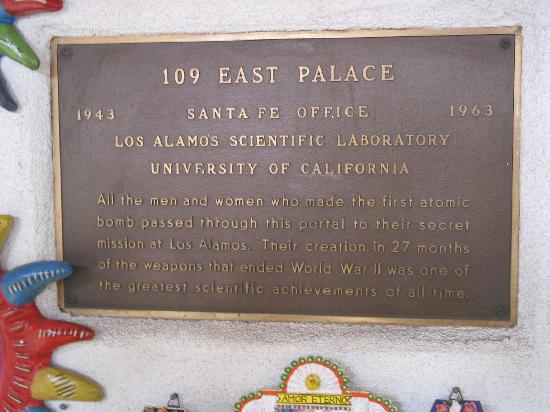
109_east_palaceI write from Santa Fe, New Mexico, where, joined by the amazing Judge Paul Grimm,  I have the enviable annual task of talking with employment law specialists about e-discovery at a venerable ALI CLE event called Current Developments in Employment Law.  Housed at the charming La Fonda Hotel, I am just steps away from 109 East Palace Street, the portal through which all civilian scientists and their families passed on their way to nearby Los Alamos to work on the Manhattan Project (so named to deflect suspicion from the real locations in Los Alamos, NM and Oak Ridge, TN).  Today, Los Alamos is world famous for the role it played in the creation of the atomic bomb; but back in 1943, Los Alamos was the most closely guarded secret in the world.  Officially, it didn’t exist.  You couldn’t even send mail there.  Instead, all communications came addressed to “Box 1663, Santa Fe, New Mexico.”

When in Los Alamos, I never fail to visit a little gem called the Norris E. Bradbury Science Museum.  The Bradbury has incomparable exhibits exploring the lives of the many ordinary and extraordinary people who changed the world at an old ranch school in the high desert.  It’s also a great place to get up close and personal with a nuclear warhead.  Admission is free, but you still need to pass through military checkpoints to come into town.

It will come as no surprise that I am passionate about computers.  Heck, I could look at computers all day (and often do)  But, you may be surprised to learn that computers played a big part in the development of the first Los Alamos A-bombs (code named Fat Man and Little Boy).  Los Alamos had the finest computers that money could buy.  Why am I so enamored of computers from that long-ago era?  Check out this clip from the new television series, Manhattan, to find out.

They sure don’t make ’em like they used to.

Unconscionable

Before I limited my law practice to work for courts and counsel, I was a trial lawyer working for contingent fees.  For 20+ years, I never charged for an hour of my time.  I funded the cases, did the work and was paid only if I recovered damages for my clients.  I charged 40% plus expenses; so, for the most part my clients and I shared roughly equally in the outcome.  At the time, I thought my fees proper, and they were certainly “industry standard.”  Everyone charged about the same, not from collusion but from plagiarism: lawyers didn’t draft fee agreements; we copied them.

But as I look back, I see that I could have charged less—even much less—and still have made a good living.  The only limits on what I could charge were the marketplace, where I saw no competition on price, and ethical precepts dictating a lawyer may not charge an illegal or unconscionable fee.

So, as someone who made a lot of money charging more than I needed to, I’m prompted to ask:

What are unconscionable charges in e-discovery?

I’m prompted by an affidavit, a sworn statement of an e-discovery expert leading a national litigation support vendor.  I won’t name names, because this post is about practices, not people.  But the affidavit shocked my conscience.

Continue reading

Richard G. Braman, 1953-2014

Braman,-RichardIt took eons for wind-borne grit to form the red rocks of Sedona, Arizona into greatness.  It took barely 16 years for Richard Braman’s grit to form The Sedona Conference and guide it to greatness.  I’m saddened to report that Richard Braman has died after a long battle with cancer.  Richard was just 60; but, in his too-brief life, he moved something more intractable than mountains; he moved the law forward in a reasoned and just way.

Richard Braman led all of us in the “Sedona Bubble” to lay down swords and use an advocate’s more powerful weapon, dialogue.  Richard carved out room for cooperation in an adversarial system of justice.  Some thought Richard’s Cooperation Proclamation naïve; but, Richard Braman was no naïf.  He was an accomplished trial lawyer who knew the trenches yet understood how much more could be won on level ground.

Perhaps it was Richard’s keen appreciation for jazz—he’d owned a jazz club in Minneapolis—that allowed him to see how discord and harmony could co-exist. I don’t know his inspiration; but, I know he was right.

I’m also certain that we have lost an extraordinary lawyer—a gentleman, a gentle leader and a true visionary.  The next time an opponent is a bit more reasonable, a bit more straightforward in an e-discovery conference, take a moment to thank Richard Braman.  My sympathies to Richard’s family, his co-workers at The Sedona Conference, his partners at Gray Plant Mooty and the many friends, foes and colleagues fortunate to have known him.

A funeral service will be held on Saturday, June 14, 2014 at 2:00 PM in the chapel of Greer’s Mortuary of Sedona, followed by interment at Sedona Community Cemetery.  Rest in peace, Richard.