
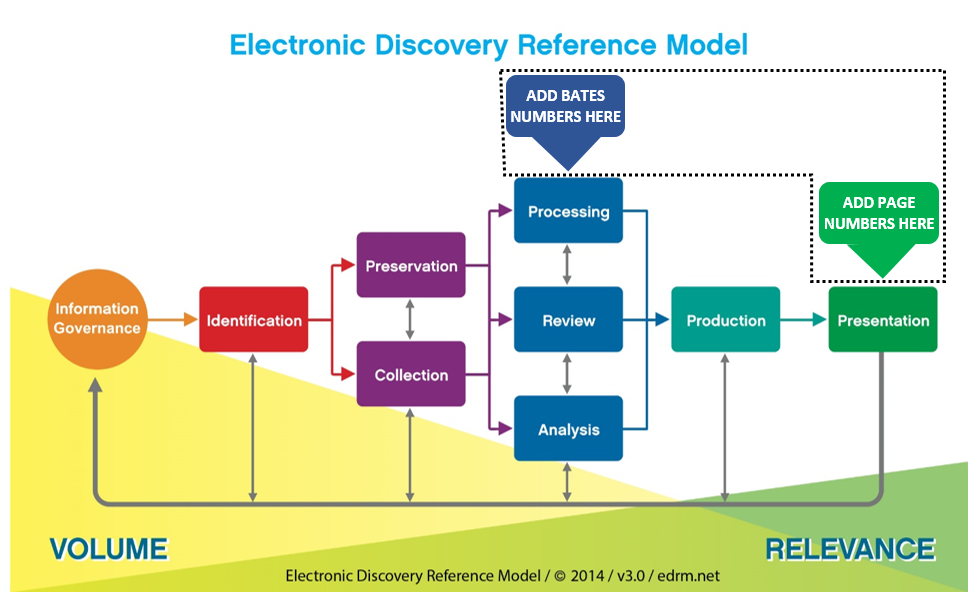
 A writer’s hubris is the conviction that when you’ve covered a topic, you’ve had your say. But new readers rarely have time or desire to plumb earlier work and, were they to try, much of what I wrote on the underpinnings of e-discovery and forensics was long ago stolen away like Persephone to a paywall-protected underworld, leaving this Demeter to mourn. So, I briefly return to a point that has never gained traction in the minds of the bar, viz. why producing in native file formats doesn’t require we give up cherished Bates numbering. Doug Austin, the Zeus of e-discovery bloggers, recently re-addressed the same topic in his estimable E-Discovery Daily. Call me a copycat, but I was here first.
As many times as I’ve written and spoken on the Native DeBates, I’ve never felt I nailed the topic. I’ve not succeeded in conveying the logic, ease and advantage of a bifurcated approach to Bates numbering and pagination. So, one more shot.
Start by imagining a world where, instead of just numbering pages, runaway enumeration demanded everyone number lines of text in each item produced in discovery. That’s not far-fetched considering that pleadings in California and deposition transcripts everywhere have long numbered lines. If I demanded that of you in discovery, wouldn’t you sensibly respond that it’s overkill and lawyers have managed just fine by numbering by page breaks instead?
Now that you’re thinking about the balance between enumeration and overkill, let’s set aside tradition and come at Bates numbering by design. Mark a fancy word: unitization. Everything is unitized: time in days and hours, buildings in square feet or meters, television in seasons and episodes, books in chapters and pages. Humans love to unitize stuff, and our units ofttimes grow from quaint and antiquated origins that we cling to because, well, uh, um, dammit, we’ve just always done it that way!
Recently, I had a tough time getting rid of perfectly nice file cabinets because they were sized to hold files fourteen inches wide. When I became a lawyer, every pleading had to be filed on fourteen-inch-long “legal size” paper, not the familiar eleven-inch letter paper. Later, courts abolished legal size pleadings and…poof…that venerable unit was history. Now, even the notion of filing paper with courts is a relic. Things changed because it was cheaper and more efficient to change. Standards do change and units do change, even in the staunchly stodgy corridors of Law. Continue reading






 Two-and-a-half years ago, I concluded a
  It’s the month for giving thanks, and I’m ever-grateful for the daily e-discovery blog penned by my friend, Doug Austin, for CloudNine. It’s tough to get out a post every business day, and Doug’s done it splendidly for, what, nine years now? Kudos! Doug’s
  Ball in your Court