• Home
  • About
  • CRAIGBALL.COM
  • Disclaimer
  • Log In

Ball in your Court

~ Musings on e-discovery & forensics.

Ball in your Court

Category Archives: Computer Forensics

Electronic Storage in a Nutshell

06 Monday May 2019

Posted by craigball in Computer Forensics, E-Discovery, General Technology Posts, Personal

≈ 4 Comments

I’ve just completed the E-Discovery Workbook for the 2019 Georgetown E-Discovery Training Academy. The Workbook readings and exercises plot the path that evidence follows from the documents lawyers use in court back to the featureless stream of binary electrical impulses common to all information stored electronically. At nearly 500 pages, the technology of e-discovery is its centerpiece, and I’ve lately added a 21-point synopsis of the storage concepts, technical takeaways and vocabulary covered. Here is that in-a-nutshell synopsis:

  1. Common law imposes a duty to preserve potentially-relevant information in anticipation of litigation
  2. Most information is electronically-stored information (ESI)
  3. Understanding ESI entails knowledge of information storage media, encodings and formats
  4. There are many types of e-storage media of differing capacities, form factors and formats:

    a) analog (phonograph record) or digital (hard drive, thumb drive, optical media)

    b) mechanical (electromagnetic hard drive, tape, etc.) or solid-state (thumb drive, SIM card, etc.)

  5. Computers don’t store “text,” “documents,” “pictures,” “sounds.” They only store bits (ones or zeroes)
  6. Digital information is encoded as numbers by applying various encoding schemes:

    a) ASCII or Unicode for alphanumeric characters;

    b) JPG for photos, DOCX for Word files, MP3 for sound files, etc.

  7. We express these numbers in a base or radix (base 2 binary, 10 decimal, 16 hexadecimal, 60 sexagesimal). E-mail messages encode attachments in base 64.
  8. The bigger the base, the smaller the space required to notate and convey the information
  9. Digitally encoded information is stored (written):

    a) physically as bytes (8-bit blocks) in sectors and partitions

    b) logically as clusters, files, folders and volumes

  10. Files use binary header signatures to identify file formats (type and structure) of data
  11. Operating systems use file systems to group information as files and manage filenames and metadata
  12. File systems employ filename extensions (e.g., .txt, .jpg, .exe) to flag formats
  13. All ESI includes a component of metadata (data about data) even if no more than needed to locate it
  14. A file’s metadata may be greater in volume or utility than the contents of the file it describes
  15. File tables hold system metadata about the file (e.g., name, locations on disk, MAC dates): it’s CONTEXT
  16. Files hold application metadata (e.g., EXIF geolocation data in photos, comments in docs): it’s CONTENT
  17. File systems allocate clusters for file storage; deleting files releases cluster allocations for reuse
  18. If unallocated clusters aren’t reused, deleted files may be recovered (“carved”) via computer forensics
  19. Forensic (“bitstream”) imaging is a method to preserve both allocated and unallocated clusters
  20. Because data are numbers, data can be digitally “fingerprinted” using one-way hash algorithms (MD5, SHA1)
  21. Hashing facilitates identification, deduplication and de-NISTing of ESI in e-discovery

All of these topics and more are covered in depth at the Academy, punctuated by substantive and substantial hands-on exercises. We ask more of the students than most seasoned e-discovery professionals can deliver. It’s hours of effort before you arrive and a full week of day and night endeavor once you’re here. Over a thousand pages of written material covered in toto.  Really, no picnic.  A true boot camp.  It exhausts and overwhelms those anticipating conventional professional education; but those who do the work emerge transformed.  They leave competent, confident and equipped with new eyes for ESI. Think you can hack it? We can help. Hope to see you there June 2-7.

P.S. No member of the Academy faculty is compensated.  We are all volunteers, there because we believe the more you know about e-discovery, the more you can contribute to the just, speedy and inexpensive administration of justice.

Share this:

  • Email a link to a friend (Opens in new window) Email
  • Print (Opens in new window) Print
  • Share on X (Opens in new window) X
  • Share on Facebook (Opens in new window) Facebook
  • Share on LinkedIn (Opens in new window) LinkedIn
Like Loading...

Mueller? Mueller? More E-Discovery Lessons from Bill and Bob

23 Tuesday Apr 2019

Posted by craigball in Computer Forensics, E-Discovery, General Technology Posts

≈ 4 Comments


I read a couple of good articles on the e-discovery implications of the Mueller report and tweeted,

“The Mueller report underscores why image+ productions are ridiculous. Compare the OCR to the true text. It’s a mess, so search is off. Image files many times larger than the native, ergo much more costly to load, store, host, transmit. BTW: YES, you CAN redact a Word file. It’s XML!”

This bears fleshing out, and I want to do it by sharing a simple trick enabling you to peer inside the raw guts of a Microsoft Word file and understand why native redaction isn’t the pipe dream some try to make it.  But first, let’s unpack the jargon.

“Image+” or “TIFF+” productions refer to the common practice of fixing the content of a document by printing the file to a static image format like TIFF or PDF.  I use “fixing” in the sense of making something permanent, but it’s also accurate to use it the way we speak of “fixing” a cat; that is, cutting its balls off.

The “plus” in TIFF+ refers to the need to supply the native file’s searchable text and application metadata in ancillary load files to accompany the page images.  That is, rather than supply the evidence, producing parties degrade it to a deconstructed “kit” version of the evidence that requesting parties must load into review platforms to restore a crude level of searchability. This enables producing parties to suppress content (like embedded comments, speaker notes and changes in text documents) and much of the application metadata of the original.  It also neuters the evidence.  It’s no longer functional in the programs that created it, like Word, PowerPoint or Excel.

I’ve written extensively about this elsewhere (e.g., Lawyers’ Guide to Forms of Production ), and I try to present the pros and cons of TIFF+, notwithstanding my belief that the cons decidedly outweigh the pros.  It largely comes down to Bates numbers and disagreement about how and when those fetishistic Bates identifiers should be added to evidence and at what absurd cost.

TIFF+ enables producing parties to sidestep their obligation to review unprinted information for responsiveness and privilege.  Instead, they silently make that content disappear like a “fixed” cat’s testicles.  To be fair, most lawyers know so little about ESI processing that they are blissfully unaware it’s happening, so they deny it with genuine equanimity.  When you force them to acknowledge the spoliation, they fall back on claiming that, whatever they excised and didn’t review wouldn’t have been worth the trouble of reviewing or producing.  Genius, right?

Apart from what’s missing from the dumbed-down data, the big objection I offer to TIFF over native productions is the huge size difference between them.  TIFF productions are much, much fatter.  Though information and utility has been stripped from the images, the degraded set is nonetheless many times larger (measured in bytes) than the native originals.

Because most e-discovery service providers price their wares by the gigabyte volume going into, onto and out of their systems, bigger files mean bigger bills.  Much bigger files mean…well, you get it.

Perhaps you’re thinking, “Craig, you sad, sad Cassandra; how much bigger can these image sets be than their native counterparts?”  Would ten times bigger surprise you? Well, then surprise!  But, they’re usually more than ten times larger.  It’s not a one-off rip-off either.  Most hosted platforms charge you for the fatter file volume every month.  Over, and over, and over again.

Sucker. Continue reading →

Share this:

  • Email a link to a friend (Opens in new window) Email
  • Print (Opens in new window) Print
  • Share on X (Opens in new window) X
  • Share on Facebook (Opens in new window) Facebook
  • Share on LinkedIn (Opens in new window) LinkedIn
Like Loading...

Storage Media: Long Past Herman Hollerith

20 Saturday Apr 2019

Posted by craigball in Computer Forensics, E-Discovery, General Technology Posts

≈ 4 Comments

It’s that semiannual time when I revise my E-Discovery Workbook in advance of the Georgetown Law Center eDiscovery Training Academy.  That means foregoing sunny Spring days in The Big Easy to pore over 500 pages of content and exercises to make them as durable and endurable as I can.  More-and-more, I find I’m adding historical perspectives.  It’s a fair criticism that, with so much to cover, I should restrict my focus to contemporary technologies and leave the trips down memory lane to my dotage.

I can’t help myself.  Though we’ve come far and fast, the information technologies of my youth are lurking just beneath the slick surfaces of the latest big thing.  The punch card storage and tabulation technologies Herman Hollerith (1860-1929) used to revolutionize the 1890 U.S. census are just a hair’s breadth behind the IBM card technologies that dominated data processing for much of the 20th century and cousin to the oily, yellow perforated paper tape that Bill Gates and I used on opposite coasts to learn to program mainframe computers via a teletype terminal in the 1970s.  The encoding schemes of that obsolete media differ from those we use today principally in speed and scale.  The binary fundamentals are still…fundamental, and connect our toil in e-discovery and computer forensics to the likes of Charles Babbage, Alan Turing, Ada Lovelace, John von Neumann, Robert Noyce and both Steves (Wozniak and Jobs).

In the space of one generation, we have come very far indeed. Continue reading →

Share this:

  • Email a link to a friend (Opens in new window) Email
  • Print (Opens in new window) Print
  • Share on X (Opens in new window) X
  • Share on Facebook (Opens in new window) Facebook
  • Share on LinkedIn (Opens in new window) LinkedIn
Like Loading...

The Computer Book: A Pleasant Stroll through the History of Computing

01 Friday Feb 2019

Posted by craigball in Computer Forensics, E-Discovery, General Technology Posts, Personal

≈ 6 Comments

I returned from frigid New York City last night, modestly triumphant that I hadn’t botched my interview with Watergate journalist and Fear author Bob Woodward.  Woodward turned out to be just the nicest guy and we got on swimmingly.  I shouldn’t be surprised as many of the highly successful people I’ve known have proved courteous and generous of spirit.  I guess nice guys finish first because we are happy to help them succeed.

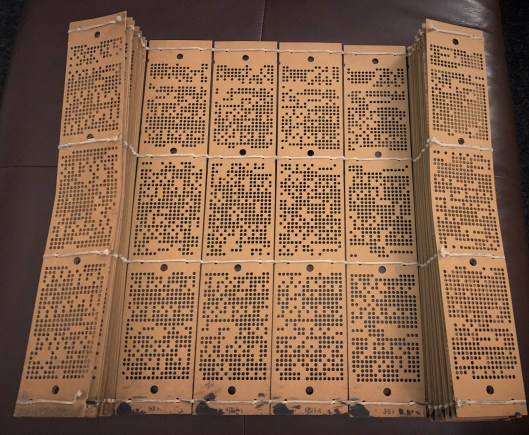
In New York, heading to the Whitney to take in the excellent Andy Warhol retrospective, I happened on an architectural antiques store in the Meatpacking District called Olde Good Things.  I love such places and was delighted to find they were selling vintage Jacquard loom cards.  I collect (NERD ALERT!) examples of milestone computing technologies, especially antecedent digital storage devices like piano rolls, magnetic core memories and, now, Jacquard loom cards!  I use these for “show-and-tell” in my digital evidence classes.  In a touching twist, the cards I bought were salvaged from an abandoned lace factory in Scranton, Pennsylvania, the old coal town a/k/a Electric City where my father grew up and is laid to rest.  Here’s my acquisition:

This digression has a purpose.  Waiting for me on my return to New Orleans was a book I’d ordered called, “The Computer Book” by Simson Garfinkel and Rachel Grunspan.  It’s subtitled, “From the Abacus to Artificial Intelligence, 250 Milestones in the History of Computer Science;” but, don’t be put off by that mouthful; it’s a delightful read and a visual feast.  Each of the 250 well-curated, chronological milestones are flanked by gorgeous full-page photography.  Among them, Milestone 13, The Jacquard Loom:

The punched cards used in the Jacquard loom circa 1801 were later adapted by inventor Herman Hollerith to tabulate the U.S. Census in 1890 and were forerunner to the punched IBM cards that were a common medium to enter and store digital data from the 1930s through 1970s.  Another descendent: the punched paper tape I used to store BASIC computer programs in high school circa 1972.  Our modern computing feats are often smaller, speedier reimaginings of age-old technologies.  The Computer Book ably underscores that evolution.

I bought the book because I’ve followed Simson Garfinkel’s extraordinary career since he was a graduate student buying second hand hard drives and scaring the snot out of people by revealing how much sensitive “deleted” data could be resurrected via forensic file carving.  That’s common knowledge now, but largely because pioneers like Simson made it so.  Simson is Professor Garfinkel today as well as the Senior Computer Scientist for Confidentiality and Disclosure Avoidance at the US Census Bureau.  Shades of Herman Hollerith! Simson holds seven patents and has published dozens of articles on computer security and digital forensics.

I’m considering making the book required reading for my law classes–something I’ve not done before as I prefer my students not go out-of-pocket.  The Computer Book succeeds in being accessible to the lay reader in a way few books about computing match. To really understand technologies, laws or people, it pays to delve into their origins.  If I ran the world, The Computer Book would be required reading for anyone in the e-discovery space.

Share this:

  • Email a link to a friend (Opens in new window) Email
  • Print (Opens in new window) Print
  • Share on X (Opens in new window) X
  • Share on Facebook (Opens in new window) Facebook
  • Share on LinkedIn (Opens in new window) LinkedIn
Like Loading...

Loving Location Histories

01 Saturday Dec 2018

Posted by craigball in Computer Forensics, E-Discovery, General Technology Posts, Uncategorized

≈ 5 Comments

I give dozens of talks each years on electronic evidence where I discuss geolocation data and its transformative potential as evidence in criminal prosecutions and civil litigation.  Smart phones constantly track our movements using gyroscopes, accelerometers, global positioning features, geolocation apps, cell tower triangulation and three independent radio systems. Our steps are tallied, altitudes logged, and, for many, vital signs are monitored, too.  We are earthbound astronauts, instrumented and coupled to sensors and telemetry as thoroughly as any who journey into space.

This doesn’t fully resonate with audiences until I guide them through their own phones, showing the level of detail with which movements are tracked.  Some listeners boast that they’ve set their privacy settings to block geolocation.  They’re the ones most surprised to learn that, although they can disable their ability to see their own geolocation history and stop geolocation data from being shared with apps, they can’t disable geolocation broadcasting and still have a functioning phone.  Here’s the bottom line: if a phone can operate as a phone, it must broadcast its geolocation coordinates with a precision of ten meters (~30 feet) or better.  U.S. law requires it.

When I broach geolocation data and see that look of “we already know this” creep across faces, that’s when I ask for a show of hands of how many in the audience use iPhones.  Nearly every hand shoots up.  I then invite them to drill down in their phone’s Settings with me to the Significant Locations logs.  Surprisingly, most have never done this before and are shocked, even frightened, by the richness of detail in the data.

To try it on your iPhone,navigate through Settings>Privacy>Location Service>System Services> Significant Locations.  Unless you’ve disabled your ability to see geolocation data, you’ll arrive at the phone’s History list setting out locales visited, and the number of sites gone to within those locales.

But, wait!  There’s more! Continue reading →

Share this:

  • Email a link to a friend (Opens in new window) Email
  • Print (Opens in new window) Print
  • Share on X (Opens in new window) X
  • Share on Facebook (Opens in new window) Facebook
  • Share on LinkedIn (Opens in new window) LinkedIn
Like Loading...

Cloud Takeouts: Can I Get That to Go?

07 Wednesday Nov 2018

Posted by craigball in Computer Forensics, E-Discovery, General Technology Posts, Uncategorized

≈ 7 Comments

Apple take outTwo-and-a-half years ago, I concluded a post with this bluster:

“Listen, Amazon, Apple, Microsoft and all the other companies collecting vast volumes of our data through intelligent agents, apps and social networking sites, you must afford us a ready means to see and repatriate our data.  It’s not enough to let us grab snatches via an unwieldy item-by-item interface.  We have legal duties to meet, and if you wish to be partners in our digital lives, you must afford us reasonable means by which we can comply with the law when we anticipate litigation or respond to discovery. You owe us that.  Alexa, are you listening?”

Amazon hasn’t listened; but, Apple lately gave users the ability to download our data.  Credit for this awakening goes to the European Union’s Global Data Protection Regulation (GDPR) that went into effect on May 25.

Data takeout capabilities are essential to protecting civil liberties and meeting legal duties.  Google’s given users a simple, effective means to repatriate data (including Gmail and calendar data) for five years, although search histories have only been supplied for two.  Twitter’s supported robust data takeout for five years; and eight years ago, Facebook became the first big social media site to offer its users the ability to download contributed content.

Apple is late to the party but it didn’t come empty-handed.  The Apple takeout is extensive and can be huge.  My download comprised 63GB in 26 compressed Zip archive files.  It took Apple five days to assemble the data and make it available for download; then, I had to download each file, one-by-one.  There’s no way to download them all, leaving the distinct impression that Apple doesn’t want takeout to be too easy.  In fairness, had I opted to have Apple deliver my data in 25GB chunks (the largest chunk option) instead of the 5GB file limit I specified, it would have been easier.

In my case, almost all the volume were photos replicated in iCloud.  Notably absent was my messaging, which Apple can’t archive and thus can only be obtained from the iPhone or a backup of same (see my post Mobile to the Mainstream). Continue reading →

Share this:

  • Email a link to a friend (Opens in new window) Email
  • Print (Opens in new window) Print
  • Share on X (Opens in new window) X
  • Share on Facebook (Opens in new window) Facebook
  • Share on LinkedIn (Opens in new window) LinkedIn
Like Loading...

Mad About Metadata

02 Friday Nov 2018

Posted by craigball in Computer Forensics, E-Discovery, Uncategorized

≈ 2 Comments

mad about metadataIt’s the month for giving thanks, and I’m ever-grateful for the daily e-discovery blog penned by my friend, Doug Austin, for CloudNine.  It’s tough to get out a post every business day, and Doug’s done it splendidly for, what, nine years now?  Kudos!  Doug’s EDiscovery Daily blog is often my first heads-up for new e-discovery cases, true again for the decision he featured this morning,  Metlife Inv’rs. USA Ins. Co. v. Lindsey, No. 2:16-CV-97 (N.D. Ind. Oct. 25, 2018)

It’s a familiar scenario.  The requesting party expressly demands native file production.  The responding party, a big insurance company, produces static image formats as non-searchable PDFs.  When the requesting party objects, the carrier argues that the metadata it strips from the evidence isn’t relevant and that the request for native forms is disproportionate, again challenging relevance, and also claiming that producing in the native forms sought would be cumulative because (chutzpah!) they’d already produced in PDF over their opponent’s timely objection.

To its credit, the Court makes short work of MetLife’s high-handedness and orders native production but stumbles a bit on the relevance and scope issues.  The Court addresses the relevance objection by noting that native production may shed light on who accessed information and that this may inform whether the insurer had a duty to investigate the policy application.  Maybe.  More likely, it won’t.  But, the Court shouldn’t have let itself be drawn in by a specious relevance challenge.

There are two varieties of file metadata: application metadata and system metadata.  Relevance should never matter for application metadata or dog tag system metadata.  If a file is sufficiently relevant to be responsive, no requesting party should be required to further demonstrate that metadata within the file is independently relevant.  The burden to prove a right to excise parts of relevant files should rest with the party altering the evidence.  Moreover, a file’s name, path and last modified date (“dog tag” metadata) are so patently useful that their utility more than relevance should serve as  sufficient basis for the production of essential system metadata. Continue reading →

Share this:

  • Email a link to a friend (Opens in new window) Email
  • Print (Opens in new window) Print
  • Share on X (Opens in new window) X
  • Share on Facebook (Opens in new window) Facebook
  • Share on LinkedIn (Opens in new window) LinkedIn
Like Loading...

Mobile to the Mainstream

17 Wednesday Oct 2018

Posted by craigball in Computer Forensics, E-Discovery, General Technology Posts, Uncategorized

≈ 12 Comments

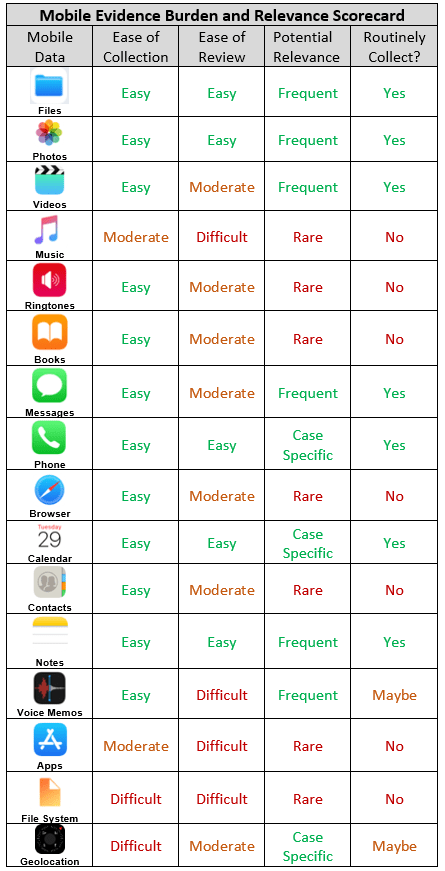
Mobile data burden and relevance scorecard

Click f/ PDF

Once you’ve preserved the contents of a mobile device, how do you extract responsive content in forms that are searchable and amenable to review?  Most information items on mobile devices aren’t “documents” that can be printed to a static format for review.  Instead, much mobile content is fielded data that must retain a measure of structural integrity for intelligibility.  This article looks at simple, low-cost approaches to getting relevant and responsive mobile data into a standard e-discovery review workflow, and offers a Mobile Evidence Scorecard designed to start a dialogue leading to a consensus about what forms of mobile content should be routinely collected and reviewed in e-discovery, without the need for digital  forensic examination. Continue reading →

Share this:

  • Email a link to a friend (Opens in new window) Email
  • Print (Opens in new window) Print
  • Share on X (Opens in new window) X
  • Share on Facebook (Opens in new window) Facebook
  • Share on LinkedIn (Opens in new window) LinkedIn
Like Loading...

On the Road Again: PREX and FEST

24 Monday Sep 2018

Posted by craigball in Computer Forensics, E-Discovery, General Technology Posts, Personal, Uncategorized

≈ Comments Off on On the Road Again: PREX and FEST

PREXFEST_SMThe Texan in me can’t hear the phrase “on the road again” without also hearing Willie Nelson’s nasal voice singing it.  But, the life I love IS making music with my friends, if by “music” we mean bringing “aha” moments to lawyers and others interested in e-discovery and forensic technology.

Today, I head to Portland, for the 2018 Preservation Excellence or PREX Conference put on annually by the good folks at Zapproved.  It’s a splendid faculty congregated in an always-lovely venue and punctuated by good conversation, fine food and the splendor that is Oregon in September.  PREX is always worth the trip; so, if you have the chance to go, by all means, attend.

This year I have a lot to do at PREX.  I have the privilege to host a keynote discussion with CNN and The New Yorker magazine legal commentator, Jeffrey Toobin.  You can be sure that the U.S. Supreme Court, the Mueller investigation and Brett Kavanaugh’s confirmation hearing will all come up.  Toobin is a bestselling author of seven books, including several on the Supreme Court and on the O.J. Simpson murder case and kidnapped heiress Patty Hearst.  Talking with Toobin rounds out my opportunity to do Charlie Rose-style conversations with Doris Kearns Goodwin and Nina Totenberg at earlier Zapproved events.

I’ll also moderate a “People’s Court” debate between Brett Tarr and Dan Nichols.  Brett is Chief Counsel for E-Discovery and Information Governance at gaming conglomerate Caesars Entertainment, and Dan is a partner with Redgrave LLP, the far-flung corporate e-discovery consultancy.  These two really despise each other, so there’s sure to be a lot of eye-gouging and attacks on legitimate parentage.  (That’s my story, and I’m sticking to it).

Finally on Wednesday, I’ll be doing a little speaking of my own in a lonely breakout session where we will talk about preserving and discovering evidence on mobile phones.  They’ve titled it, OMG, SMS & ESI: Preserving & Collecting from Mobile Devices.  The session description reads:

How does one craft a discovery request for text messages? What are the different techniques for preservation, collection and review of mobile data? When does it make sense to complete a full forensic collection on a mobile device? This session will deliver foundational information and practical examples of process and policy management for mobile devices in ediscovery.

if you haven’t yet come to grips with mainstreaming mobile devices into day-to-day e-discovery, know you’re not alone–everyone is struggling, or more likely closing their eyes, hoping mobile will go away.  Perhaps we can make some progress together.

PREX  September 25 – 27, 2018  |  Portland, OR

Then, no-rest-for-the-dreary, I wing to the Windy City of Chicago (so-called NOT due to weather, but for the propensity of its politicians to pontificate at length).  I’m heading to the annual Relativity Fest, a stupendous amalgamation of e-discovery education and evangelical tent meeting cum rock concert.  If there were the slightest doubt that Relativity dominates the e-discovery review space (and is hungry to gobble up the rest of the EDRM), such foolish doubt will be crushed by the power of Fest.

I enjoy Fest for many reasons, not the least of which is the chance to work with the always-engaging David Horrigan, Relativity’s discovery counsel and legal content director.  David is a fine writer, insightful commentator and skilled teacher.  Eclipsing that is his distinction as a great guy, someone always fun to be around and adept at eliciting the best from those he hosts.

At Fest, David will moderate a panel I’m on called The Internet of Things from a Legal, Regulatory, and Technical Perspective.  I’m fortunate to join Gail Gottehrer, Partner and Co-Chair of the Privacy, Cybersecurity, and Emerging Technology Practice at Akerman, who will give the regulatory perspective, and Ed McAndrew, Partner at Ballard Spahr and former DOJ cybercrime coordinator, who’s charged with the legal point of view.  I guess that leaves the technical stuff to me, which is where I’m happiest anyway.

Relativity Fest  Sep. 30 – Oct. 3, 2018 | Hilton Chicago

I hope to see you at one or both of these exciting confabs, enjoying two fine faculties in wonderful venues.  The joy and value of these events isn’t just what’s planned, but the interactions around and outside of the sessions, too.


Share this:

  • Email a link to a friend (Opens in new window) Email
  • Print (Opens in new window) Print
  • Share on X (Opens in new window) X
  • Share on Facebook (Opens in new window) Facebook
  • Share on LinkedIn (Opens in new window) LinkedIn
Like Loading...

Easing the Pain of Protective Orders

03 Monday Sep 2018

Posted by craigball in Computer Forensics, E-Discovery, Uncategorized

≈ 3 Comments

protective_orderDoes anyone read what they sign anymore?  We all click through EULA’s; but shouldn’t lawyers and experts pay close attention to the terms of protective orders?

Here’s a familiar scenario:

Client says, “we have discovery responses you need to review, sign this acknowledgement to be bound by a protective order.”  I read the order and respond, “I can’t,” adding, “Like you, I have work product to protect, and like you, I back up my data.  I can’t ‘return’ data residing on backups.  I’ll carefully protect the data, but I can’t commit to destroy or return it when the case concludes.”

I’m the bad guy because everyone else signs.

First, let me further explain the conundrum.  Continue reading →

Share this:

  • Email a link to a friend (Opens in new window) Email
  • Print (Opens in new window) Print
  • Share on X (Opens in new window) X
  • Share on Facebook (Opens in new window) Facebook
  • Share on LinkedIn (Opens in new window) LinkedIn
Like Loading...
← Older posts
Newer posts →
Follow Ball in your Court on WordPress.com

Enter your email address to subscribe to this blog and receive notifications of new posts by email.

Join 2,233 other subscribers

Recent Posts

  • Free at Last: Ditching TurboTax for FreeTaxUSA April 5, 2026
  • A Dog and Its Tail: Don’t Let Version Uncertainty Cloud Linked Attachment Production April 2, 2026
  • The EDRM Isn’t Broken; It’s Misunderstood. March 18, 2026
  • Detecting Deep Fakes February 24, 2026
  • A Fun Way to Build AI Fluency February 21, 2026

Archives

RSS Feed RSS - Posts

CRAIGBALL.COM

Helping lawyers master technology

Categories

EDD Blogroll

  • Basics of E-Discovery (Exterro)
  • eDiscovery Today (Doug Austin)
  • E-Discovery Law Alert (Gibbons)
  • eDiscovery Journal (Greg Buckles)
  • E-D Team (Ralph Losey)
  • The Relativity Blog
  • Minerva 26 (Kelly Twigger)
  • CS DISCO Blog
  • GLTC (Tom O'Connor)
  • Sedona Conference
  • Corporate E-Discovery Blog (Zapproved )
  • Complex Discovery (Rob Robinson)
  • Illuminating eDiscovery (Lighthouse)

Admin

  • Create account
  • Log in
  • Entries feed
  • Comments feed
  • WordPress.com

Enter your email address to follow Ball in Your Court and receive notifications of new posts by email.

Website Powered by WordPress.com.

  • Subscribe Subscribed
    • Ball in your Court
    • Join 2,085 other subscribers
    • Already have a WordPress.com account? Log in now.
    • Ball in your Court
    • Subscribe Subscribed
    • Sign up
    • Log in
    • Report this content
    • View site in Reader
    • Manage subscriptions
    • Collapse this bar
 

Loading Comments...
 

    %d